A provider's guide to recruiting support workers: From job ads to rebooking
Are you seeking an easier, more reliable way to recruit high-quality support workers? Our guide will help you attract the right support workers, streamline hiring, and build a stronger team.
Jump to section:

Hiring and retaining support workers has never been more challenging for disability and aged care providers.
With fewer workers in the labour pool and more employers competing for them, building a team you can rely on can seem like a never-ending battle. Without a reliable team, you suffer from increased complaints and incidents, higher rates of overtime, and increased staff burnout.
If you find available support workers, there's no guarantee they have the proper training, registrations, and experience to provide high-quality and consistent support for your NDIS and Aged Care participants.
But having a trusted team of skilled and reliable support workers is critical to your business's success.
So, how can you improve your hiring process and build a strong workforce?
In this comprehensive guide for providers, we'll explain the key phases of an effective recruitment process. Follow these nine steps, and you'll be well on your way to building an all-star team.
Let's dive in.
Step 1. Knowing your needs
Effective recruitment hinges on matching the right support workers to both the role and your organisation's culture. This means finding individuals whose skills and experiences are well-aligned with your client's requirements, ensuring they can seamlessly support your organisation.
Begin by evaluating your organisation's needs:
- What are your goals?
undefined - What locations or regions do you need to cover?
- How many workers do you need to maintain consistent and reliable support?
Next, zoom in on specific participant needs:
- What qualifications and skills are required to support the client? This might include certifications or specific training, such as administering medication.
- Are there high-intensity support needs, such as complex bowel care, feeding tubes, or urinary catheters?
Taking time upfront to assess your needs fully means you can go into the recruitment process confident that you know what you're looking for and can identify the right candidate when you meet them.
Struggling to find the right staff?
Traditional job boards may bring quantity over quality, and agencies can limit your control while increasing costs. At Hireup, we do things differently.
- As an NDIS-registered provider, we connect you with over 10,000 first-aid-certified and NDIS-verified workers, prioritising quality and reliability.
- We handle payroll, insurance, and compliance, so you can focus on what matters—finding the right people.
- With our platform, you stay in control, easily managing and scheduling your workforce without hidden fees.
Step 2. Choosing a recruitment source
With your hiring criteria in place, you're ready to search for the right candidates. But where do you look?
There are three traditional sources of recruitment for providers, each with its pros and cons:
- Online job boards: Traditionally, providers have turned to online job boards like Indeed, Seek, and LinkedIn to fill roles. Job boards offer extensive reach, but they do not screen applicants, which means it can be a full-time job to sift through applicants who may not have the qualifications you're looking for.
- Labour hire and recruitment agencies: These agencies offer a flexible workforce and alleviate some administrative burdens, providing access to a pool of skilled workers. However, drawbacks include a potential lack of control over worker scheduling and availability, as well as possible high fees and unexpected charges.
- Online platforms for providers: Online platforms provide a selection of support workers for you to browse on the platform. The advantages of online platforms are that they have often been developed with the NDIS or aged care in mind, so you know they understand your needs well. Fees are often transparent or may be negotiated with individual contractors, and you have the option to see readily available workers at your fingertips.
Traditionally, the support workers are independent and not hired by the platform. This means there can be limited recourse if things go wrong, as it's unclear who is liable. The growing popularity of online platforms has also led to a proliferation of support workers signing up, which has impacted quality control. There is little or no consistency around their qualifications and training, and they may have limited experience working with participants.
As the sector's needs grow, it's essential to consider how these traditional methods align with your current and future requirements.
Hireup for Providers provides an alternative labour hire solution.
Hireup for Providers is an innovative provider platform connecting you with over 10,000 NDIS-verified disability and aged care support workers. Distinguishing itself from other platforms, Hireup is NDIS-registered and employs all workers directly, ensuring reliability and accountability.
Key benefits of Hireup for Providers:
- As an NDIS-registered organisation, Hireup manages all compliance and worker screening, reducing the burden on providers.
- All support workers are first-aid certified, have passed the NDIS Worker Screening Check or its equivalent, and undergo mandatory safety training with options for specialised training.
- Hireup offers a transparent pricing model with no hidden fees, contracts or minimum spend, making it a cost-effective solution.
- Our self-service tools empower you to select, communicate with, and manage workers more efficiently, facilitating quicker scheduling and rebooking of preferred workers.
- As your workforce needs grow, additional support and account management are readily available through Hireup.
By choosing Hireup for Providers, you gain a dependable recruitment partner that enhances your ability to meet complex staffing needs efficiently and effectively.
Step 3. Finding workers
One of the biggest challenges providers face is worker shortages. According to the NDIS Review, the sector needs to find another 128,000 workers by June 2025 to fully meet demand.
That's where Hireup for Providers can help.
We have over 10,000 trained and NDIS-verified workers on Hireup who are ready to support your clients. With Hireup, the challenge isn't finding support workers but ensuring you find the best match. You need to stand out from other providers and win over candidates for your jobs.
Here's how:
Craft an irresistible job post.
Think of the Hireup job post as your job ad. It's the first impression you'll make to candidates and sets the base for your entire recruitment process.
If the job advertisement is compelling, you will attract qualified support workers who match your needs and are interested in what your organisation offers. If not, your job ad will go unnoticed or attract the wrong people, wasting your time and effort.
How do you write the perfect job post?
Let's break it down:
- Outline the role and responsibilities: Be clear and honest about the job responsibilities and expectations, so that the worker can make an informed decision about whether it's the right match for them.
- Be specific about the time and day: The more specific you are, the more likely those applying will be available for your job. Is it ongoing shift work? Outline the shift schedule and the routine tasks required for morning, afternoon and evening shifts.
- Location type: Where is the support to be carried out? e.g., in the client's home, supported independent living, provider's community centre, in the community, etc.
- Communicate your hiring criteria: List any required qualifications and skills. For example, you may need trained workers to help with specialised support, such as catheter care, complex bowel care, tube feeding, behavioural support, medication, and mealtimes.
- Emphasise the rewards: What makes your organisation unique, e.g. opportunities for training or flexibility in scheduling? How does your company support the development and well-being of your support workers?
- Be concise: Trim unnecessary words and use bullet points to make your job post punchy but clear.
Pro Tip: Hireup lets you duplicate job posts, saving you time when recruiting for repeated or similar jobs.
Make a connection
Once you have a shortlist, it's time to learn more about the applicant's experience and background. Hireup lets you securely message suitable workers through the platform so you can check that they have the skills and experience required for your job and understand what they are agreeing to.
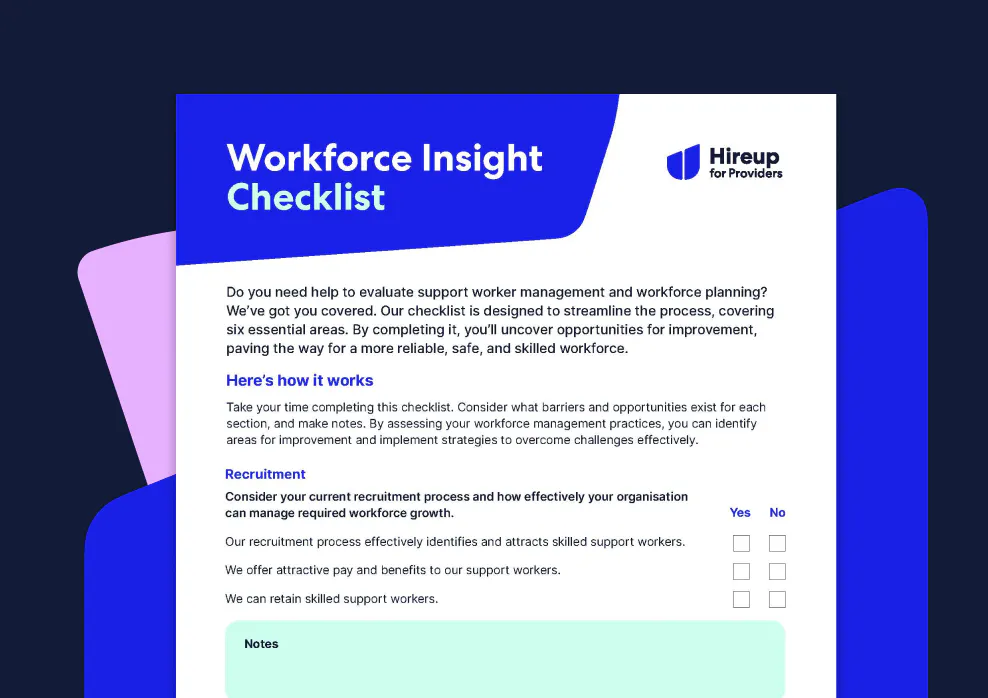
Ready to overcome your workforce challenges?
Download our free checklist:
- Uncover opportunities in six essential areas of support worker management and workforce planning.
- Identify barriers, make notes, and implement effective strategies for a more reliable, safe and skilled workforce.
- Assess your practices and make necessary adjustments for enhanced workforce management.
Step 4. Interviewing and meet-and-greets
No matter how strong their resume is, before you make your first booking, you should always meet the workers to get a feel for what they're like and whether they'll be a good fit.
Set up an interview or meet and greet.
On Hireup, you can book a 15-minute meet-and-greet with the support worker via phone, video, or in person. This free service is designed to help you determine whether they are a match.
Getting the most out of the meeting comes down to your questions. Your goal is to leave the interview confident that the candidate can provide the high-quality care you and your clients need.
The most effective way to do this is to ask a range of questions, including:
Direct questions: Start with direct questions to get a clear picture of the candidate's skills, qualifications and background:
- How long have you been a support worker?
- What type of certifications and training do you have?
- How many years of experience do you have in support work?
- What attracted you to support work as a job?
Behavioural questions: Understand a candidate's skill level and how they act and react in a specific setting or situation:
- Tell me about a time when you dealt with a difficult client, conflict or challenging behaviour.
- Describe a situation where you had to make a difficult decision at work.
- Tell me about a time when you went above and beyond for a client.
- How do you manage working under pressure?
Hypothetical questions: Assess the candidate's problem-solving skills and how quickly they can think on their feet. Communication is an essential skill for support workers, and scenario-based questions let you see how clearly they can express themselves:
- What would you do if a client refused to take their medication?
- How would you handle a client's condition that is upsetting you?
- How would you build a relationship with a new client who is resistant to receiving care?
- How would you manage a medical emergency?
Skill Questions: Drill down into their specific skills and experience:
- Describe your experience with personal care tasks such as bathing, dressing, and toileting.
- Are you comfortable with administering medications to clients?
- Describe your experience with mealtime management, tube feeding, bowel care, and urinary care.
- Do you have experience providing support for people with dementia or Alzheimer's, diabetes, and epilepsy?
Narrow down your candidates.
Next, use Hireup's search and filter functions to narrow the pool of support workers based on criteria such as location, skills, and qualifications.
Then, save a shortlist of potential support workers who have applied based on their profiles and suitability for the job. This will help you compare applicants and find the best match quickly and easily.
Step 5. Creating a booking
Once you've conducted all your interviews, it's time to select your candidates. Choose the best-fit candidate based on their skills, experience, and attitude.
Hireup makes it easy to book your preferred support worker.
- Go to their profile and click the Book button below their name, or if you've been messaging the worker, you can click the Book button in the messaging window.
- On the Booking page, add a start date, start time, and finish time. Tick the "repeat booking" and "vehicle allowance box" as needed.
- Then, add a short description outlining the job, including the tasks and outcomes, whether specialised support is required, and anything else the support worker needs to know. For example: "Some personal care, cooking lunch, and a quick trip to the shops."
The support worker will receive your request and can choose to accept or decline. If they accept, they will be added to your team, which you can view anytime on your Dashboard.
Step 6. Onboarding and buddy shifts
Once the support worker has accepted your job, the onboarding process begins. Onboarding is a critical step in supporting the worker. The more supported they feel from the outset, the more likely they will want to work with you again.
The onboarding process can often be time-consuming for both the employer and the worker, but Hireup simplifies this process for providers by providing training to all support workers.
All Hireup support workers are NDIS registered, first aid certified and have already completed five mandatory training courses:
- Working with purpose: Learning about the NDIS and their role in providing effective and individualised support.
- Working safely: Learning about safe and effective support, preventing and responding to abuse and neglect, and tips for their own health and well-being.
- Preventing and responding to abuse and neglect: Learning about Hireup's zero-tolerance approach to abuse and neglect and understanding their role in preventing, responding to, and reporting it.
- Infection Control: Learning about infection control, including personal hygiene, PPE, and risk assessment.
- Manual Handling: Learning about manual handling, including the anatomy of the spine, injury prevention, and safe techniques.
Because some jobs require specialised support or tailored training, Hireup can arrange additional training to suit your needs before your worker starts a shift, so you can be confident they are fully prepared.
For example, for Sunnyhaven Disability Services, Hireup's team takes charge of worker briefings and shares house profiles, relieving the provider of the burden of training costs associated with new workers and ensuring workers are well-prepared for their assignments.
Another critical element to onboarding is buddy shifts. Buddy shifts allow new support workers to shadow an existing support worker during a shift to familiarise themselves with the participant's needs and routines.
Step 7. Rebooking preferred workers and managing bookings
Now you have started building an all-star team of support workers, how do you retain them?
Continuity of care is critical for NDIS and Aged Care participants. It allows support workers to develop a deep understanding of their participants' needs, preferences, and unique circumstances and means the participant feels more valued, respected, and empowered. This level of familiarity also fosters trust, which is fundamental for participants.
Hireup makes it easy for providers to save and rebook preferred workers for future shifts so you can deliver continuity of care.
Juggling staff availability, fluctuating demand and everyone's flexibility needs can be a headache without the right tools. Every minute spent on rostering is a minute away from your critical business needs.
Hireup centralises the whole process of making and managing bookings, giving you all the tools in one platform. If you need multiple support workers for concurrent shifts, you can easily create and manage bookings and view them in the centralised Dashboard. With bookings and communications in one place, roster management is a breeze, and there is less paperwork, emails and phone calls to sift through.
Pro Tip: Hireup lets you duplicate bookings, minimising redundant data entry and simplifying the scheduling of recurring bookings.
Admin is streamlined, too – rather than dealing with complex invoices for each worker and job, you receive one itemised, consolidated weekly invoice delivered straight to your inbox.
Summary
If traditional recruitment methods aren't delivering the high-quality support workers you need, it's time for a strategy shift. Hireup offers an alternative solution, giving providers access to registered and trained NDIS and Aged Care support workers who excel in delivering individualised care and support.
Hireup for Providers is designed to enhance HR efficiency. It provides a seamless, time-saving experience from hiring and onboarding to rostering and managing bookings. This will not only fill your workforce gaps but also enhance service quality, participant trust, and staff loyalty.
Request a live demo or enquire today
Learn more about what Hireup for Providers can do for you.