Overcoming the support worker shortage: What providers need to know
Are you struggling with the ongoing shortage of skilled support workers? Discover how to tackle this issue head-on, ensuring your organisation remains equipped to meet the growing demand for quality disability support services.
Jump to section:

The National Disability Insurance Scheme (NDIS) has undoubtedly revolutionised disability support in Australia, empowering individuals with disabilities to lead fulfilling lives. However, behind the Scheme’s noble intentions lies a pressing challenge: a significant shortage of support workers.
Although the industry is filled with a broad and eclectic mix of highly experienced, skilled and dedicated individuals, there simply aren’t enough of them to keep up with the skyrocketing demand for NDIS services.
Despite the presence of a highly experienced and dedicated workforce, the demand for NDIS services far outstrips the supply of available support workers. By 2025, the sector will need an additional 128,000 workers.
To put this in perspective, this is:
- Equivalent to 1.2 times the full seating capacity of the MCG (~100,000 spectators).
- Half the population of Hobart (~271,675) or about 27% of Canberra's population (~478,000).
- More than twice the number of participants in this year's London Marathon (~53,000 runners).
Unpacking the complexities of shortage
The shortage of support workers within the NDIS ecosystem is multifaceted and deeply impactful on the people working in the sector, as well as participants needing to access support. From burnout among existing support workers, to the struggle of providers to sustain an adequate, skilled workforce, to participants dealing with changing support workers and schedules; the challenges are widespread and affect all segments of the disability support sector.
So, if the talent pool isn’t growing fast enough, how can service organisations build new (and retain) high-quality teams that meet the demand for NDIS services?
To address this question, we surveyed 75 senior leaders from disability service providers, shedding light through our Shared Workforce Report on the impacts and critical themes that are currently shaping the future of workforce models in disability care.
So, what are the issues?
Recruiting (and retaining) high-quality staff
A stable workforce is key to the sustainability of the sector and the businesses within it; however, recruitment and retention strategies are putting this stability at risk. The sector’s already existing worker shortages were only exacerbated by the challenges posed by the COVID-19 pandemic.
In fact, 78% of the providers we surveyed say they’re finding it extremely or moderately difficult to recruit workers.
This reflects the major shift in labour market trends we’ve seen over the last few years, with the workforce moving away from providers in favour of ABN contracting. This phenomenon has put a significant strain on the capacity of providers to retain staff.
Using agency workers, or overtime to cover vacancies, are only short-gap measures that often don’t provide the desired outcomes of building a stable and reliable workforce that enables a business to scale.
In fact, 55% of senior leaders from disability care providers identified a shortage of qualified staff as a barrier to growing their business.
Recruitment troubles also limit the access available to suitable support for some NDIS participants. Staff shortages place pressure on existing workers (particularly in regional and remote areas), as well as on particular participant groups, such as those with complex support needs. With 53% of the senior leaders ranking client-centred care prioritising their client’s individual needs and preferences as a short-term priority, a new workforce solution must be implemented.
Financial pressures
In our Shared Workforce Report, 7 in 10 surveyed providers identified financial pressures, such as rising costs and an uneven regulatory playing field, as the top barrier to growing their disability care business. Financial efficiencies and sustainable growth are top of mind for the leaders we surveyed, with 68% of providers anticipating that financial sustainability will remain their primary long-term business focus beyond the next six months.
As employers battle to find enough staff for their participants’ needs, it’s never been more important to offer competitive pay as an employee value proposition, which can be challenging for businesses to both offer initially as a recruitment tactic, and maintain on an ongoing basis as a way to retain staff.
Investing in attracting and retaining staff takes time and money, and can be difficult with the currently fragmented state of the sector (as well as strenuous to manage within the NDIS pricing structure).
Other sector challenges
Providers also face a host of other challenges when managing their casual workforce.
- 55% of support workers have multiple jobs (and therefore usually limited capacity), leading to difficulty rostering and juggling staff.
- The care support industry tends to be perceived as offering limited career progression and skill development opportunities, making it difficult to attract new staff.
- With many staff encouraged to do overtime due to shortages, the risk of burnout and high staff turnover rates are high.
How can NDIS-registered providers overcome these challenges?
Research has indicated that retaining existing support workers is considered to be the most effective strategy for addressing the shortage of staff in the disability support sector. This is followed by attracting more support workers, and then by sharing existing support workers within the industry more effectively.
Having surveyed providers and reviewed some suggested solutions, we’re excited to introduce a groundbreaking new model that promises to revolutionise the way we approach workforce management in the disability sector.
For providers, a ‘shared workforce model’ helps alleviate staff shortages and absences, and increases access to qualified staff. It delivers operational and financial efficiencies by using available support workers and greater ability to fill gaps in regions where support workers are sparse.
In our Shared Workforce Report, many providers told us that from their perspective, a shared workforce model overwhelmingly offers greater job security, scheduling flexibility, skills development, and a career pathway for support workers. Most importantly, for people with a disability seeking support, the model strengthens the ability to make sure that they receive consistent and uninterrupted care.
With 23% of providers currently using or having adopted a shared workforce model, the main outcome is clear: this model is expected to provide better quality support workers, and that’s something the entire sector can agree is needed.
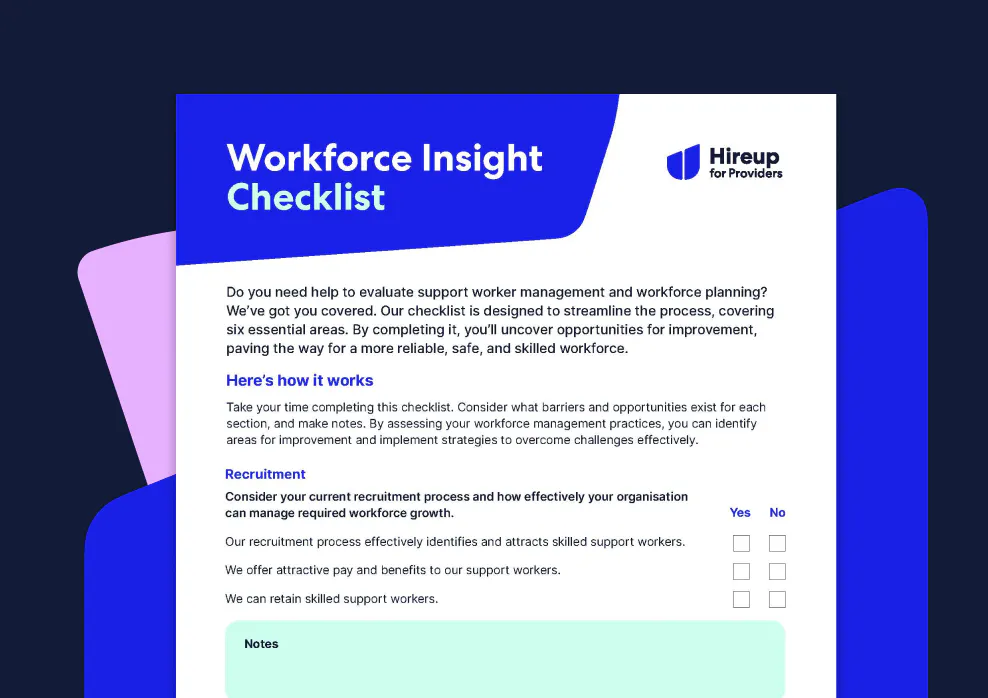
Ready to overcome your workforce challenges?
Download our free checklist:
- Uncover opportunities in six essential areas of support worker management and workforce planning.
- Identify barriers, make notes, and implement effective strategies for a more reliable, safe and skilled workforce.
- Assess your practices and make necessary adjustments for enhanced workforce management.
Understanding the shared workforce model
The shared workforce model is based around the concept of creating a pool of skilled talent for an industry to leverage, and has been a point of discussion amongst labour market experts for some time.
In our research, we’ve defined a shared workforce model as a labour arrangement where multiple organisations collaborate to utilise a common pool of workers.
How does the use of a shared workforce model differ from the use of agency workers in the disability sector?
In a shared workforce model, the host provider is able to choose the support worker, rather than this being controlled by the agency. Both the shared workforce provider and the host provider collaborate on workforce training and development, and host providers are able to communicate directly with their workforce. Employment transitions are facilitated and supported between both parties, leading to a number of operational and financial efficiencies.
The shared workforce model provides both transparency and clarity, enabling care providers to easily see the qualifications and real experience of their workers, with us not always possible with the traditional labour hire agency model.
At Hireup, we exist to enable the pursuit of a good life for everyone – our clients, support workers, and partners. We created Hireup for Providers, our innovative staffing solution for NDIS and Aged Care providers, in response to COVID-related staff shortages to support the sector by sharing our own workforce.
Using Hireup for Providers will not only help you to fill gaps in your roster with qualified workers and easily find specialised support for your clients; you’ll also be able to seamlessly explore long-term workforce solutions and unlock a wide variety of operational and financial efficiencies for your business.
Through the platform, you’ll gain access to over 10,000 employed, trained and NDIS-verified disability and aged care workers. With transparent pricing and no extra fees, we’re a smart and highly adoptable alternative to traditional labour agencies, where you’re able to screen, communicate and book shifts directly with your workers (just as your clients do).
Our workers:
- Are first-aid certified and have passed the NDIS Worker Screening Check (or equivalent)
- Have completed mandatory safety training (with customisable specialist training modules available)
- Provide 1:1 support (NDIS and aged care), Supported Independent Living, specialised disability accommodation support, and group programs.
Benefits of the shared workforce model
Unprecedented adaptability for providers
In the disability support sector, workforce stability is not just a preference, but a strategic necessity for long-term sustainability. Working with diverse clients who have unique needs, providers need support workers who are both flexible and stable.
Recruiting and retaining qualified workers that fit that need isn’t easy, and the shortage of qualified staff has become a costly workforce crisis, threatens client-centred care, and inhibits business growth.
In our Shared Workforce Report, more than half (57%) of the senior leaders from disability care providers we surveyed agreed that a shared workforce model can make disability care services in Australia more sustainable. They recognised that the model can improve efficiency and productivity for businesses, including through the new level of flexibility and scalability it offers compared to previous workforce management systems.
With the shared workforce model, you’re able to:
- Collaborate across different providers to better handle workforce volatility
- Move away from competing with other NDIS providers for the same pool of scarce labour
- Utilise a workforce that wants more shifts, feeding both your recruitment pipeline and filling your casual staffing pools
- Build your team and work on your longer-term workforce development goals, as opposed to just filling gaps
Better outcomes for participants
Most importantly, for people with a disability seeking support, the shared workforce model strengthens the ability to ensure that they receive consistent and uninterrupted care. The model allows providers to meet fluctuating staff demands without compromising on the quality of care their business is able to provide.
You’ll be able to make sure that every one of your support workers meets your training and quality requirements, providing excellent service to participants and representing your business in the best possible way.
Watch our video to learn how Hireup can:
- Connect you with 10,000 verified support workers and
- Simplify the process from job posting to onboarding
- Ensure you find the perfect fit for your team
Partnering with Hireup
By using Hireup for Providers, you’ll be able to alleviate the financial burden and operational difficulties that come with recruiting and retaining quality support workers, by sharing those costs and resources with other users.
The Hireup team works closely with our registered providers to collaborate on recruitment and onboarding processes to ensure they’re aligned with your organisational values and standards.
We help you to implement specialised training to enhance the skills and capabilities of support workers, directly addressing the perception that the care industry has limited opportunities for learning or career progression.
Entering into a shared workforce partnership with us will also mean you’re potentially able to offer more competitive pay to your workers and a wider array of benefits, which has been shown to mean that your support workers will stay with your business for longer.
In our report, we asked providers what their experiences were utilising a shared workforce model.
Of the surveyed providers:
- 67% of them agreed that support workers have increased flexibility in their work schedules and in choosing their work
- 60% said support workers gain an expanded skill set through exposure to different care practices
- 60% expected support workers to have potentially increased incomes.
In this case, the shared workforce model is a win for both care providers wanting to offer quality and continuous care to participants, as well as the dedicated, talented and deserving support staff who work to make it happen.
A new era of care with the shared workforce model
As the support worker shortage continues to challenge NDIS providers, building a shared workforce partnership with Hireup emerges as a promising solution.
By leveraging the flexibility, scalability, and resources offered by the shared workforce model, providers can better navigate the challenges posed by the support worker shortage in the disability care sector, while still ensuring they’re delivering high-quality care to participants and ensuring the long-term sustainability of their businesses.
Watch a demo now or enquire with us today to learn more about Hireup for Providers.
Please note that Hireup for providers is only for providers that are registered NDIS or My Aged Care providers - your business cannot be unregistered.
