
In defence of her family’s right, Melanie Dimmitt found herself pondering a notoriously fiery topic.
I’ve been waiting for this to happen. When it finally did, it was by the beach, at the height of summer, in a stretch of highly coveted car bays. It happened while my partner and I were unloading our son’s wheelchair, when a man approached our boot and said, “You know that’s a disabled parking spot, yeah?”
In a split second I’d spun around to face him. “Have you met our son?” I snapped.
The force of my response sent this guy flying, stammering an apology to the tune of: “Sorry, I’ve just seen other people getting booked for parking here.”
Good, I thought. People should be penalised for parking in spaces they shouldn’t. Spaces that allow people like my kid - and families like ours - to enjoy a sunny day like anyone else. Does this man think he’s a hero for protecting perpetrators, or performing a civic duty?
I suppose he’s doing better than the schmuck who, a couple of weeks ago, decided to wedge their car between two accessible parking spots at a shopping centre. One could even argue that had we not had a mobility permit, his intervention could have cleared the bay for someone who needed it. But who is this guy - or anyone - to determine who needs what?
This intrusion into our day, while startling, didn’t come as a surprise. Again, I’ve been waiting for this to happen. Friends with disability have told tales of being cross-examined by strangers. Other parents have lamented battling it out with non-disabled families for accessible spaces in school car parks.
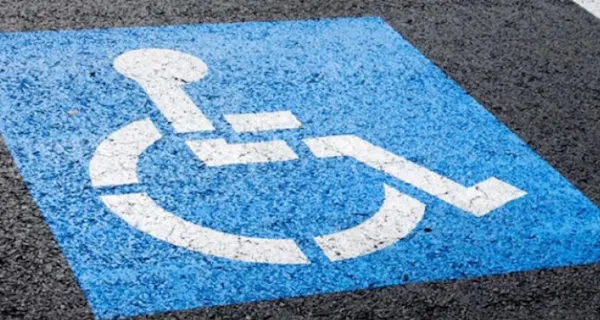
Perhaps we should count ourselves lucky that our son’s condition is visible. His wheelchair irrefutably abides by the image spray-painted on the asphalt and emblazoned on the square of plastic suctioned to our windscreen. Why a wheelchair is the international symbol for disability, when less than 5 per cent of disabled Australians actually use one, beats me. But my son’s certainly helped illustrate our position - and our right to it.

Image: Melanie Dimmitt and her son, Arlo
Such is not the case for Katie Brebner Griffin, who has a dynamic disability that fluctuates in severity. Katie recently shared her story of finding a note slotted under her windscreen wiper, written by a fellow permit holder who’d seen Katie walking out of her car. “This is an abuse of parking,” read the note. “I’m in a wheelchair and can’t park. You should be ashamed.”
Katie said she’s received several of these notes before, but never from a person with disability. Her story raises the question, if people in our own patch are making misguided assumptions, what hope is there for that bloke we met at the beach?
The solution, I think, is trust. If someone has a mobility permit, trust that they’ve gone through the necessary checks to possess it. If someone’s parked in an accessible parking bay with no permit, trust that they’ll be fined for it. Or publicly shamed on social media - perhaps even the mainstream media, like the schmuck who straddled two accessible bays at the shopping centre.
For what it’s worth, we had a great day at the beach. And while I’m still shocked by my snarky response to being questioned, I hope to have sufficiently scared at least one person out of assuming anything of anyone’s chosen spot.

Melanie Dimmitt
Melanie Dimmitt is a freelance journalist, author and broadcaster. Since her debut book, Special, was published by Ventura Press in 2019, Melanie has written, spoken, podcasted and advocated far and wide for disability families. Creator and host of the award-winning NDIS Know-how and Tubie Talks podcasts, Melanie also publishes an annual magazine, The Blend, for the tube-feeding community.