
Mealtimes are an important ritual in our everyday lives, and they should be safe and enjoyable for everyone.
For people with disability who need support to eat and drink, it’s essential to have a plan in place that outlines their needs. This is especially important if a person has dysphagia, or difficulty with swallowing, as there’s often a risk of choking or aspiration.
So, what is mealtime management, and what support is available?
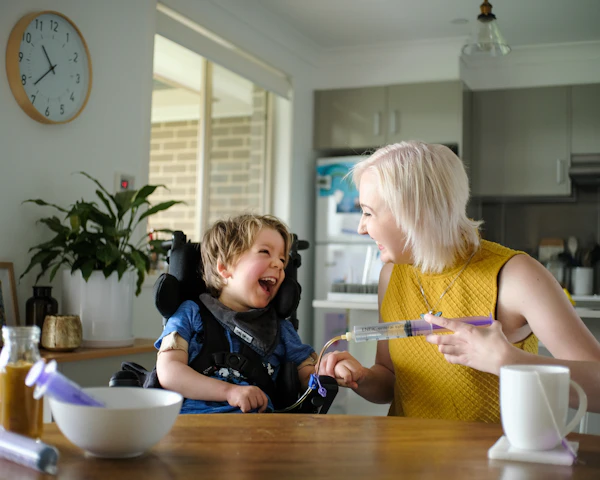
Mealtime management is the approach taken to ensure a person with disability can enjoy meals safely. A proper assessment of a person’s needs can reduce the negative impacts of dysphagia or other mealtime issues, and improve a person’s safety and quality of life.
But the most important element of mealtime management is making sure sharing food and drink is an enjoyable experience.
Hireup’s own news and features Commissioning Editor Melanie (Mel) Dimmitt makes mealtime fun for her seven-year-old son Arlo, who started tube feeding about two years ago. “Being in the tube-feeding space, mealtimes can all feel a bit medical,” Mel says.
At first, Arlo, who has quadriplegic cerebral palsy, was eating pureed food by mouth, and Mel says the family thought he was doing quite well with his feeding. But multiple bouts of pneumonia and hospital admissions pointed to an unseen problem. After having a modified barium swallow (MBS) procedure, it was revealed Arlo had in fact been silently aspirating on every mouthful, so the decision was made to transition to feeding through a gastrostomy tube (G-tube).

“There’s a lot of stuff that needs to be done around feeding Arlo. There’s a lot that needs to be prepared,” Mel says. The family blends meals for Arlo that are inserted into his tube with syringes. He takes various medications as well, and care must be taken to ensure all the equipment is kept clean, in the same way we practise good hygiene around food consumed through the mouth.
Mel and her partner Rowan prioritise the social aspect of sharing a meal together at the dining table for Arlo and their five-year-old daughter Odette, who they call Odie. “Arlo eats at the same time as his sister. He sits with his sister. He’ll sit with his tube, and she’ll sit with her little plate of food,” Mel says. “I think it’s great that Odie is growing up around Arlo and his friends with disabilities, because I wish I’d had that perspective on the world when I was growing up.”
Mel emphasises the benefit of having a great support worker who has the skills and knowledge to help with mealtime management. “We have a wonderful, amazing support worker called Maddy, who we’ve been working with for over two years now… and she’s been on the whole tube-feeding ride with us,” Mel says. “She’s been learning with us the whole time… Having her by our side through this tube feeding adventure has been a godsend.”
Hireup has support workers on board who are specifically trained in tube feeding, but prior experience is not essential — Maddy learned alongside Mel’s family as they transitioned to tube feeding Arlo. The important thing is to find a support worker who is willing to learn and eager to support whatever mealtime management needs a person has, Mel says. “For us it’s important to have someone who’s going to muck in with the family, and who knows it’s going to be messy!”
Mel’s advice to those needing mealtime support is to make sure mealtime management is part of your wider NDIS plan. You must provide evidence to show that you need support with feeding, which can take the form of letters from specialists such as your dietician or speech therapist. And it’s essential that each time you have a review, you outline exactly what you need, and continually update your evidence.
So whether we’re eating at home with a support worker, grabbing a bite at a cafe, or enjoying a feast for a family celebration, mealtime management ensures everyone can safely eat, drink and be merry. Cheers to that!

Phoebe Hartley
Phoebe Hartley is a Melbourne-born writer and audio producer with a background in filmmaking, now living and working at the foot of a mountain on Wurundjeri Woi Wurrung land in regional Victoria. She is the founder of Small Town Writing Co., helping broad-minded businesses and humane humans tell stories that move.