
Hireup speaks with Benison O'Reilly and Seana Smith - co-authors of “the essential guide” for parents of children with autism - about their new, fully updated edition.
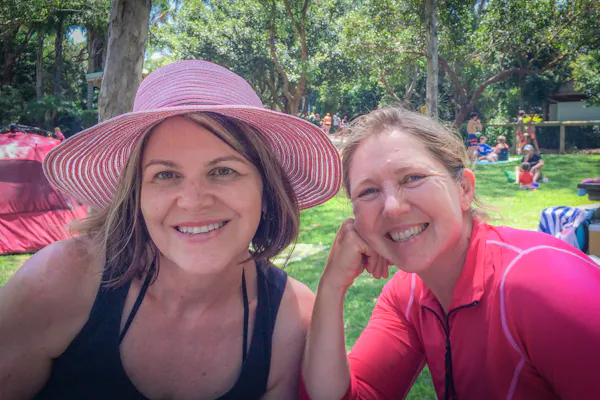
Image: The Australian Autism Handbook authors Benison O'Reilly and Seana Smith
The Australian Autism Handbook is back - and it’s had a makeover. First published in 2008, this info-packed tome has accompanied countless families through the fog of an autism diagnosis. It’s also seen a lot of change, with advocates skyrocketing awareness and of course, the rollout of Australia’s National Disability Insurance Scheme (NDIS).
Benison O'Reilly and Seana Smith’s sons were diagnosed with autism at age three, prompting the pair to write the guide to parenting children with autism they wished they’d had to hand at the time. As they promote the new edition of their book, the co-authors share what it was like to revisit their work and bring it up to speed with the present - and very promising - era.
Melanie Dimmitt: Huge congrats on the new edition! How does it feel to have your book back out in the world?
Seana Smith: It's really exciting to mark how things have changed for the better since our own sons were diagnosed when they were little. And I think the new book really reflects so many of those changes. Most importantly, we’ve got the voices of young people with autism and adults with autism, which we didn't have in the first edition of the book.
Benison O'Reilly: Yes, things have changed a lot. When our children were diagnosed there was no financial support. You were basically all self-funded or you relied on the public services. People would cash in their superannuation and forgo having a house so they could provide therapy for their children.
When the first edition of the book came out, I think the Helping Children with Autism Package had just come in and that was some money. But compared to the NDIS, it’s completely different. It’s nice to have that terrible anxiety taken away from families.
MD: Speaking of anxiety, what was the process of revisiting and re-writing your book like?
BO: There were some chapters and sections where I went, ‘Oh my God, did I really write that sort of stuff? It sounds very unpolitically correct now!’ Other sections around some of the more technical stuff, especially around the medical side of it, actually haven't changed that much in a decade. Whereas things around language and how you speak about people with autism has changed a lot. So there was definitely some finessing of the language.
MD: You’re bringing this new edition out into a very different media landscape. How do you feel about autism being represented by advocates like Chloe Hayden and Grace Tame?
SS: There is a better representation in the media now, generally from people who are pretty articulate. Articulate people will always be telling the story - and that is not my son, so I don't see my own son represented except in the program about dating on the spectrum. But things have improved so much that I'm never going to complain about where we are in the media now.
BO: It is a vexed topic. I know that parents of children with more profound needs sometimes do feel a bit marginalised in the discussions these days. But it's better than what it was. I mean when our sons were younger, ‘Rainman’ was it, you know? That's what people’s view of autism was. At least there's diversity out there now. I think ‘Love on the Spectrum’ is a good show because it does feature quite a diverse range of people.
MD: In the new edition of your book, how have you dealt with therapies for autism? Applied Behaviour Analysis (ABA), for example, might have been more popular when you brought out the first edition, but it’s now very polarising.
BB: It was certainly polarising back then too. When we brought out the first edition there was some hostility toward our mentioning it, particularly amongst professionals. In the new edition, the section on ABA was the hardest thing I wrote in the book because I was trying to acknowledge both sides. Acknowledge things that were bad about ABA, but also saying what our experiences were and what some current experiences are in Australia. But I might have displeased everyone by trying to hedge my bets there.
I believe ABA is not a therapy for kids who are only mildly affected. I think it’s for those children who really struggle to learn any other way. It worked for my son, who seemed almost unteachable until someone showed him how to to sit down and pay attention, and then everything flowed from that. Speech therapy and occupational therapy were useless until he started ABA. For people like my child, I still think it was a very valuable therapy.
MD: Seana, you mentioned that there are voices from people with autism in this new edition. Can you share some of the advice they passed on to parents?
SS: Not having set expectations and children being allowed to be who they were - those were very important lessons. And if you’re a neurotypical adult who doesn't experience sensory sensitivities, you need to hear from somebody else who can articulate what that’s like when light really does hurt your eyes, or your brain shuts down when there’s noise. If something's overwhelming, you want to get away from it. So, knowing that behaviour is communication is really important.
Before your child’s diagnosis, you just think that there's something wrong with you as a parent. And that’s why your child is not interacting with you, not playing with toys or running away. By the time my son was diagnosed at three years old, I was a very demoralised parent that thought I was doing all wrong. Which I was, for that child.
I think that parents deserve a lot of empathy, encouragement, love and care because things that should be coming easily are definitely not. And you almost need to wind back all the things you thought you should be doing and change them.
MD: Benison, what advice from this section of the book do you wish you’d known when your son Sam was diagnosed with autism?
BO: Knowing ‘why I stim’ is really important. When Sam was young and started at ABA, this was something that therapists tried to stamp out. Not so much in Sam’s program, because I was uncomfortable with it. But now we have these very articulate adults saying that stimming is a regulating thing that manages their anxiety. Even though it can look off-putting to outsiders, there’s a function to it. I think that would be very helpful for parents who’ve got young children - to have these people explaining this to them and seeing that these people are doing very well in their adult lives, but still like to stim as well.
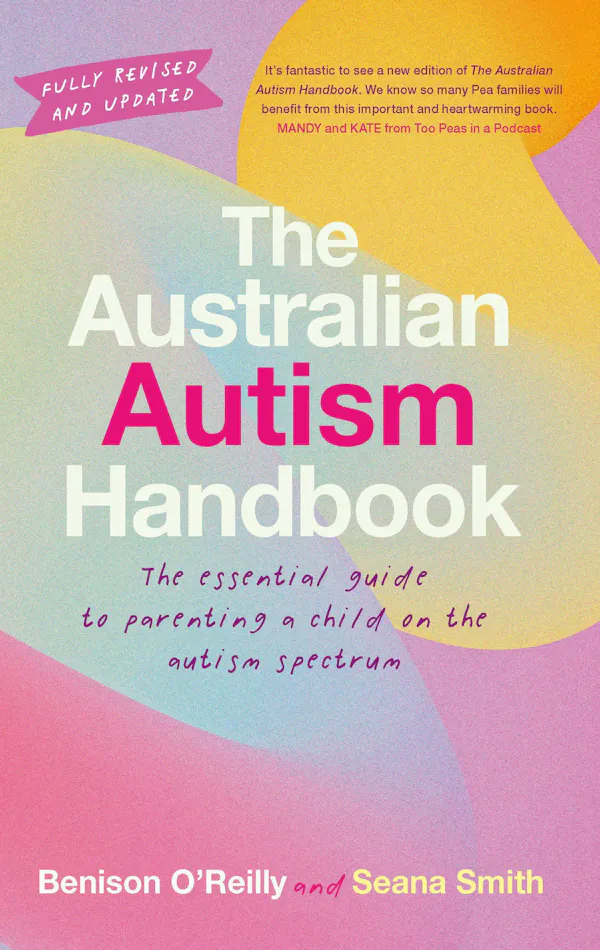
The Australian Autism Handbook is published by Ventura Press and available to purchase at all good booksellers.

Melanie Dimmitt
Melanie Dimmitt is a freelance journalist, author and broadcaster. Since her debut book, Special, was published by Ventura Press in 2019, Melanie has written, spoken, podcasted and advocated far and wide for disability families. Creator and host of the award-winning NDIS Know-how and Tubie Talks podcasts, Melanie also publishes an annual magazine, The Blend, for the tube-feeding community.