
Day after day my son, Arlo, arrives home from kindergarten with drawings, letters and birthday party invites spilling out of his school bag. Friendly tokens flow freely from Arlo’s classmates, none of whom seem bothered by his wheelchair or lack of speech. Arlo’s peers share his passions for The Teeny Tiny Stevies, Pig the Pug and Bluey. And when he skips school for appointments or hospital stays, he’s missed.
“Frankie has come home asking if Arlo is okay because he hasn’t been to school for a little bit,” read a recent text to me from Frankie’s mum. “She’s just a little concerned. Hope everything is okay and we will have to catch up for a playdate soon.”
Everything was okay, and Arlo and Frankie had their playdate.
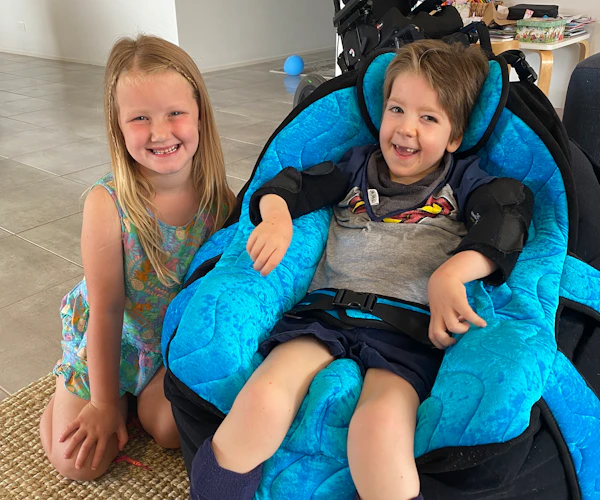
Image: Arlo and his kindergarten friend, Frankie.
A couple of weeks ago, Dylan Alcott said that when he was five, he had no friends. This, from our celebrated athlete and affable Australian of the Year. All because he grew up with disability in a culture that segregated kids based on their bodies.
At primary school in the ’90s, I didn’t have any disabled friends. Back then, students with disability would learn in different rooms, with different teachers. I don’t remember seeing anyone with disability on the playground at lunchtime, so I suspect these kids had a different schedule. Or simply weren’t there.
According to a report by Dr Molly de Lemos, the former President of Learning Difficulties Australia, in 1992, under half (49 per cent) of Australian children with disabilities were attending “regular” schools. Thirty years on, things have changed.
Now almost 90 per cent of Aussie school students with disability go to a mainstream school, with the majority (71 per cent) of this cohort only attending “regular” classes, as opposed to specialised classes and units.
My son, Arlo, is one of them. He’s been beautifully included in mainstream education settings since age two, when he started at Rose Cottage, an early childhood education centre in Sydney’s inner-west where you’ll find director, Tara Kelly.
“We’re here to build connections with families and make differences in children’s lives. So when I heard you were coming to see our centre, I thought, ‘I can’t wait to meet that family. I can’t wait to welcome them into the service and give them all the support that they need’,” Tara says.
“I was excited because I knew our educators would also benefit from this, too, in being able to really see what inclusion looks like and feels like - what it’s meant to be.”
Arlo made fast friends at Rose Cottage. He also pulled focus to what truly matters in life.
“Parents will often ask, when will my child learn to read and write?” Tara tells me. “Yes, these things are important, but in their first five years, we want our kids to learn how to have empathy for others. We want them to gain emotional intelligence. We want them to know that friendship means loving and caring about someone regardless of anything - and that’s what happened here. Arlo’s friends loved reading and singing with him. He would smile at them and they would smile back. There was so much love, not only from the children, but their parents, too.”

Image: Arlo paints with a friend at Rose Cottage.
As Arlo’s school bag gathered love notes, his sister, Odette, also started at Rose Cottage. The pair relished their time there, right up until we relocated to the Southern Highlands. Sadly, this saw Arlo waving goodbye to his Rose Cottage friends. However, he’d soon be making more.
Pauline Iacono is the director of Mittagong Preschool and, in her 25 years at this mainstream centre, she’s never seen a child with disability not successfully included.
“It’s always just worked, so why would you do anything different?” says Pauline. “Young children are so accepting. They don’t discriminate. They just take people as they are and if they're nice to them and give them a smile, well then they'll give them a smile back.”
Sharing how her preschool benefited from having Arlo in the classroom, Pauline’s careful not to paint him as an educational “tool”.
“I feel like I learn from everyone I come into contact with,” she says. “Parents teach me things, colleagues teach me things - and the children, every day, surprise me with the things they do and say. So in that way, I feel like Arlo taught us all a lot. He taught us how to include him by showing himself to us and by feeling comfortable enough to be himself.”
From the kids’ point of view, Pauline says Arlo was a positive, smiling friend.
“Interaction with an array of people from different cultures and capabilities is what makes us become who we're meant to be,” she says. “Being friends with someone like Arlo helps children to unlock communication strategies to make sure they’re getting the messages he’s giving.”
Arlo is non-speaking, but makes himself known in many other ways. His friends are well-versed in his favourite songs, books and games. They’re skilled at wrangling his wheelchair and delighted when he walks alongside them in his frame. They’ll sit happily by his side, holding his hand, exchanging cheeky glances.
Image: Arlo shows off his artwork with a friend at Mittagong Preschool.
This year Arlo started kindergarten at our local public school with full-time, one-on-one support. Once again, our family was welcomed. Once again, Arlo has made great friends. Including Frankie.
“Children learn that it’s okay to be different,” says Moss Vale Public School principal Katherine Hurst, when asked why she advocates for inclusion. “They learn that they can interact with other children and not just children in wheelchairs, but other children who have other supports in the classroom. Children learn that support is for everybody.”
Not all families have experiences like ours, where their children are accepted and supported in mainstream educational settings. Friends of mine whose kids also started primary school this year have told me horror stories, making me very aware of just how lucky we got.
When asked how to get inclusion right, Arlo’s school principal, Katherine, says it requires constant communication with a child’s family.
“We always ensure that consultation takes place with parents,” she says. “We listen to the views of the parents, to what priorities they have in terms of outcomes for their child’s education, and we work together with them to make sure that we find the most appropriate setting for each individual family.”
From a preschool perspective, Pauline advises educators to show confidence when supporting children with disability. “Just respond to the child,” she says. “Be aware of their needs, but respond to the child. Our training is all about observation. If you respond, observe and respond to each individual child, you will be successful.”
Back at Rose Cottage, Tara says the language used around inclusion in educational settings is key.
“Somebody might think, okay, we have inclusion support funding and we’ve got an additional educator, they'll be on Arlo. And it’s like, no! No one’s on anyone! If an additional educator is the only one supporting a child and the other educators have nothing to do with them, that’s excluding, not including. Inclusion support is meant to support educators to provide an inclusive environment for all children.”
And that’s all our kids need in order to have a social life - an inclusive environment. Once they’re on the playground, at the pool or in the classroom, children do their thing. They connect, find common ground and never once question, why can’t we be friends?
As the new school starts, connect with local support workers who can provide support in learning and education, and assist with morning and afternoon routines.
Register with Hireup for support that suits you and your family.
Melanie Dimmitt
Melanie Dimmitt is a freelance journalist, author and broadcaster. Since her debut book, Special, was published by Ventura Press in 2019, Melanie has written, spoken, podcasted and advocated far and wide for disability families. Creator and host of the award-winning NDIS Know-how and Tubie Talks podcasts, Melanie also publishes an annual magazine, The Blend, for the tube-feeding community.