
Here’s what The Blend magazine editor and Tubie Talks podcast host, Melanie Dimmitt, has learned from people and families who are eating, drinking and thriving with feeding tubes.
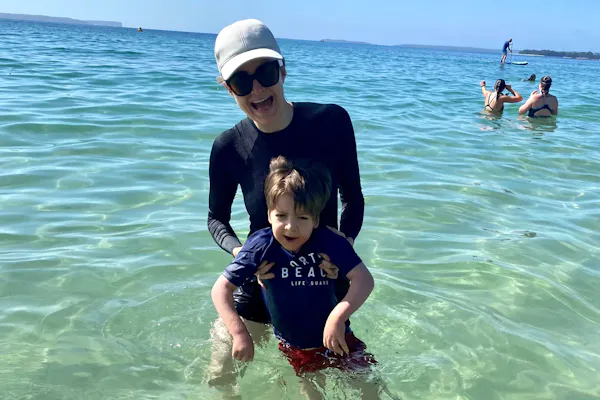
I’m going to start by saying that, three years ago, I struggled with the notion of my kid needing a feeding tube. As far as I knew, tubes doing the work of body parts meant sickness, sadness and decline. Feeding tubes were for cancer patients and people in palliative care, were they not? So when this notion became a non-negotiable for Arlo, my cheerful son, I was a mess.
This wasn’t Arlo’s first medical intervention. He’d already gotten comfortable in wheelchairs and walkers. He’d found his way of talking without words, a wicked sense of humour and a knack for winning hearts. All of this came naturally to our bright, beautiful boy who, at six months old, was diagnosed with cerebral palsy. But eating and drinking safely, so we discovered, did not.
Just before Arlo turned five, a modified barium swallow x-ray caught him silently aspirating on every bite of food and sip of water we were helping him take. A stern recommendation of “nil by mouth” saw Arlo’s gastrostomy procedure swiftly scheduled – and my heart metaphorically stomped.
Something about Arlo no longer tasting, chewing and swallowing really stung. He seemed to so enjoy his meals, spooned into his mouth with a side of book reading or, on more trying days, cartoons with his sister. Was the ritual of sharing food not the glue that brought people together, the maker of memories, the very stuff of life?
Nevertheless, Arlo’s gastrostomy (G) tube went in and, before long, he was back at the table, next to his sister, filling up on his favourite pureed meals in far less risky fashion.
I’ve skipped over a very steep learning curve there, so let’s dig into some of the biggest revelations that have come from tube-feeding my son and talking with other people and families in the tube-feeding space.
1. Feeding tubes are life-makers
Time and time again, tube-feeders and their families have told me how grateful they are for the clever contraptions that are nasogastric (NG), gastrostomy (G), jejunostomy (J) tubes and total parenteral nutrition (TPN), all of which have been literal lifelines for nurse and social media influencer, Steph Kelly. “Feeding-tubes are not the enemy,” said Steph when chatting for the current issue of The Blend magazine. “They are the reason why I’m still here.”
Over on episode five of the Tubie Talks podcast, Elli Kilpatrick, who has a J-tube, says, “I can go to pilates, I can go to the beach, I go to festivals – I do so many cool things because of my tube. It’s been a big flip from being like, ‘that would be the worst thing ever’, to, ‘I’m just so grateful for it’. I have this wonderful quality of life and I’ve done some amazing things because I’ve had the ability to get nutrition, despite what my stomach has decided to do on the day.”
2. Tube-feeding can be taught
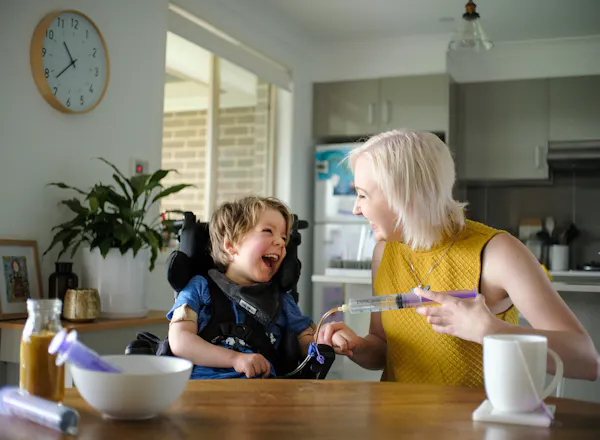
Back when we were preparing to leave the hospital after Arlo’s G-tube was placed, I remember struggling, with two hands, to clamp and unclamp his tube. A nurse said to me: “You’ll be doing that with one hand before you know it.” I didn’t believe her, but she was bang on the money. Nowadays, clamping is a cinch for me – as it is for Arlo’s support team.
We were lucky to have our Hireup support worker, Maddy, by our side for every step, spill and squirt of Arlo’s transition to tube-feeding. “I’d never worked with anyone who was tube-fed”, she says in episode one of Tubie Talks. While many support workers are trained in how to tube-feed, Maddy, like us, was just determined to learn so she could help someone she cares for.
“It just feels normal now,” she says. “Arlo’s getting all the medications he needs, all the nutrition he needs. And he’s putting on weight – in a good way – so it’s extremely beneficial for him.”
3. It’s just a different way of doing a natural thing
In the days before Arlo’s G-tube was placed, I kept kissing his tummy. I found it hard to fathom that a hole would permanently puncture Arlo’s perfect skin and couldn’t come to terms with the idea of this open cavity, leading to his stomach.
While sympathising with my former, freaked-out self, I smile at this now. Because, isn’t that exactly what a mouth is?
As tube-feeding bodybuilder, Pedro Relvas, told me during his Tubie Talks podcast episode: “I’m not inferior, there’s nothing wrong with me. The only difference between me and you is that my oesophagus is outside my body.”
Meanwhile, in a feature for the current issue of The Blend magazine, model Amelia Tang says their feeding tube “is a neutral part of my body. I don’t really see it as a good thing or a bad thing. It’s a life-saving thing. It’s as normal to me as my nose or my mouth.”
4. Sometimes, tube-feeders can still eat real food
Let’s pop a major disclaimer on this point: please consult with your medical team to sort out the right diet for you.
For Arlo, it’s a blended diet, which means real food, blended up to a milkshake consistency so it can flow through his tube. When Arlo first started tube-feeding – unsuccessfully, on his prescription of commercial formula – we didn’t know much about this diet as it wasn’t as widely accepted in the medical space.
Wholesome Blends founder Sarah Thomas has been working to build awareness around the benefits of a blended diet for tube-feeders like her now-teenage son, Lewis. “I truly believe that we all should be consuming a variety of nutrients, not just a sole source of nutrition,” says Sarah in Issue Two of The Blend magazine.
“I don’t eat the same thing every day, nor do I want my children to. And let’s face it, don’t we all want that occasional naughty treat? My son, Lewis, loves it when he gets a dessert blend!”
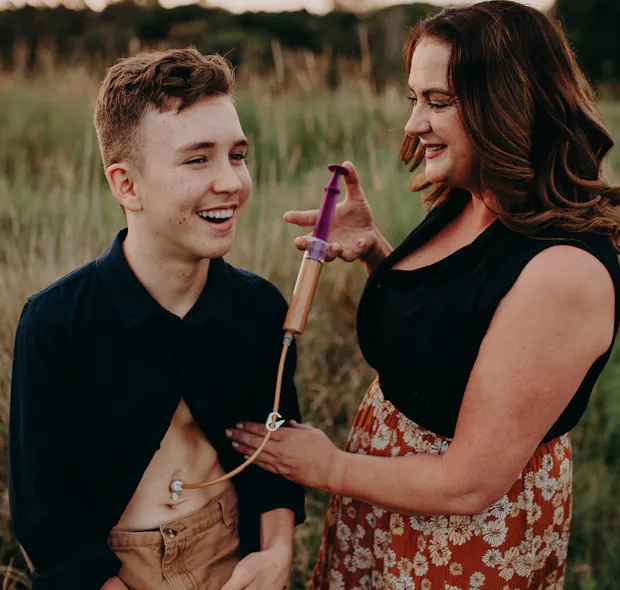
Image credit: Terra Rosa Photography.
5. The tube-feeding community is HUGE
We’re not so niche, us tubies. While the global tube-feeding market is ballooning and worth billions, across social media you’ll find millions of stories sharing glimpses of the lives of people and families who tube-feed (seriously, search for “tube feeding” on TikTok to see for yourself).
In her interview for The Blend, Lina Breik, the Tube Dietitian, said that these days, tube-feeding is “very much about autonomy, independence and people’s choice… [it’s] no longer a medical thing. And it shouldn’t be. Nutrition in the home is about love, connection and culture.”
Thanks to the advocacy of our community, the world is waking up to the reality that, for countless people and families, tube-feeding means a full, healthy life.

Melanie Dimmitt
Melanie Dimmitt is a freelance journalist, author and broadcaster. Since her debut book, Special, was published by Ventura Press in 2019, Melanie has written, spoken, podcasted and advocated far and wide for disability families. Creator and host of the award-winning NDIS Know-how and Tubie Talks podcasts, Melanie also publishes an annual magazine, The Blend, for the tube-feeding community.