
Beloved Aussie children’s cartoon, Bluey, has introduced a non-speaking pup - and shown a representation of society we need to see more of on mainstream television.
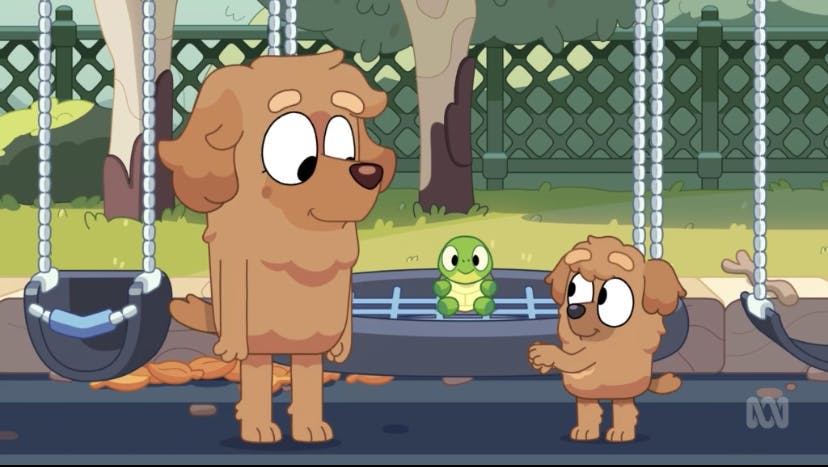
This morning, as I lounged with my six-year-old son, lapping up a long-awaited new episode of Bluey, I was taken aback by something I saw. An unknown character, in the form of a fluffy brown dog called Dougie, entered a park with his mum. Dougie doesn’t speak, so as he traverses the playground, he and his mum talk using Auslan.
This morning my son, Arlo, got to see a non-speaking kid on his favourite television show. He got to see that not every child communicates with spoken words, which is important for him to see because he, too, is non-speaking.
Arlo has a physical disability that means he doesn’t talk. He’s learning to use an augmentative and alternative communication (AAC) device that allows him to speak using his eyes, but for the most part, he communicates through facial expressions and gestures. Much like our new Bluey friend, Dougie.

This isn’t the first time Bluey has featured a character with disability. Jack, one of Bluey’s school mates, is portrayed as having attention deficit hyperactivity disorder (ADHD). However, we only come to know - or come to assume - that Jack has this condition based on the way he can’t sit still and can’t remember his school hat.
Since meeting Jack, I’ve been waiting for Bluey to represent disability in a more direct, less ambiguous way. That is, until this morning.
In today’s episode of Bluey, titled ‘Turtleboy’, lead character Bingo discovers a toy turtle at the park, which is later also found by Dougie. Bingo and Dougie both play with the turtle toy, and both follow the advice of their supervising parents in leaving the toy where they found it, in case its owner comes looking for it.
Dougie is portrayed in exactly the same light as Bingo. His disability isn’t mentioned or made a thing of. It’s simply present - as it is in the homes, schools and social circles of the 350,000+ children with disability in Australia.
The media, generally speaking, has far to go in the way of properly representing the disability community. But change is happening.
Sesame Street features a Muppet called Ameera, who has a spinal cord injury and uses a wheelchair, and another, Julia, who has autism. In 2019, Peppa Pig welcomed wheelchair-using Mandy Mouse - and was celebrated for doing so in understated fashion. As disability activist Melissa Blake wrote for The Washington Post at the time:
“When we meet Mandy, she’s described as ‘a visitor’. She’s not described as a mouse with a disability or a mouse in a wheelchair. She’s simply a visitor who greets the group with a friendly ‘hello, everyone’, to which the rest of the playgroup all reply with an enthusiastic ‘hello’.”
Bluey’s Dougie also entered the playground without fanfare or hype. In doing so, he showed millions of viewers just how commonplace his form of communication is - certainly for the 70 million people world-wide who use sign language.
Here’s hoping he and Jack are just the first of many dogs with disability to be included in the Bluey pack. One thing’s for sure - Arlo and I will be watching.
The ABC has released a version of the ‘Turtleboy’ Bluey episode accompanied by an Auslan translator, and a video teaching kids (and adults) a few signs.

Melanie Dimmitt
Melanie Dimmitt is a freelance journalist, author and broadcaster. Since her debut book, Special, was published by Ventura Press in 2019, Melanie has written, spoken, podcasted and advocated far and wide for disability families. Creator and host of the award-winning NDIS Know-how and Tubie Talks podcasts, Melanie also publishes an annual magazine, The Blend, for the tube-feeding community.