
According to Paralympics Australia, almost 20 per cent of Australians live with disability, but only 1 in 6 participate in sport. One person who participates in sport regularly is Hireup client Andew ‘Westie’ West, who says that exercise is important for keeping physically and emotionally healthy.
“I love to exercise and go to my local gym a couple of times a week and workout with a personal trainer,” he says. “I get a sense of belonging to my local community. I regularly do a spin cycle class where I feel that I'm part of the class.”
This sense of inclusion and belonging is important, as 75 per cent of Australians with disability want to take part in sport but feel there are limited opportunities.
Senior Exercise Physiologist, George Paneras at Ability Action Australia, says that inclusion and social aspects of sport are just as beneficial as the physiological benefits.
“Sport can provide an array of benefits for people with a disability,” he says. “First and foremost, the social benefits are great and provide a sense of community. This includes both individual and team sports. Sharing an interest in sport is a great way to foster positive social relationships while having fun.”
For sporting organisations, it's important to ensure that an accessible environment is the main priority. “People with a disability want to feel comfortable and want an ‘ease of access’ environment when trying sports for the first time,” George says. “This could look like having the right accessible equipment, ensuring that all safety checks are completed before accessing a sport, ensuring that all participants are medically cleared to participate in the sport. Competition is great but fostering a fun, positive and social environment will allow more people to access the sport.”
When it comes to the physiological benefits of sport for people with disability, it’s all about working on skills which translate to daily living.
“In my gym sessions I work on my core which improves my balance which helps me to perform daily tasks such as dressing,” says Andrew.
“Sport is a great way to improve your fitness and strength and gross motor skills,” George says.
“Depending on the type of sport, getting your heart rate up and breaking a sweat improves your cardiovascular health. Wheelchair basketball is a great example. Other sports which don’t require a high intensity are great for your fine motor skills such as bowling, bocce, archery, darts, golf etc. Lastly, sport allows people to set goals which can assist with motivation. When people achieve these goals, a great sense of achievement is felt. Other skills such as communication and team-work are a big part of life in general and these skills can translate into other aspects of daily life.”
Again, according to Paralympics Australia, adults with a disability are 9 times more likely to report both cardiovascular diseases and diabetes than those adults who are not living with disability.
So, the physical benefits of exercise, such as improving strength, mobility, cardiovascular fitness and health are important. An exercise physiologist can work on and recommend exercises depending on the type of sport a person is playing.
“Aerobic sport that requires you to cover a distance on a field or a court repetitively requires that person to participate in a lot of fitness-based exercise,” George says. “This includes but is not limited to running, wheelchair sprints, ski erg, spin bike. Interval training is a great way to improve fitness and allows people to work at a high intensity.
“Strength exercises are also important for all sports. Strength training is important to prevent muscular strains and strengthens our joints. For example, working on upper body strength can improve throwing performance in sports such as basketball, baseball and cricket. Strength exercises include using weight machines such as a chest press, cable row, or leg press. There are an infinite amount of exercises that a person with a disability can do.”

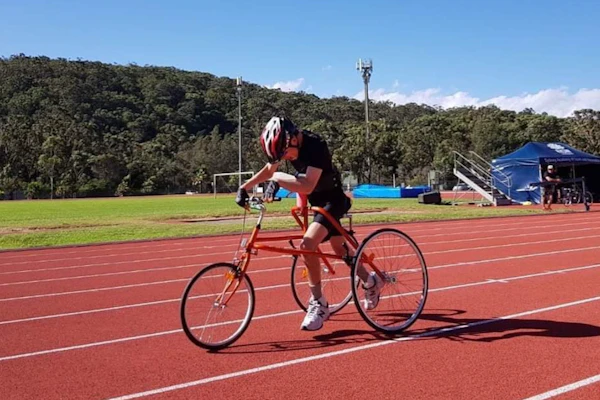
Take Andrew, for example, who along with going to the gym, also goes Framerunning training every week with a regular group. “A few of us have been training together for a while and we push each other by having friendly competition. A Frameruner is a three wheeled frame which you run in while you are supported in an upright position.”
Finally, it’s all about keeping an open mind.
“You might have seen a sport that doesn’t look fun or you might think you may not be appropriate for that certain sport,” George says.
“There are a range of sports today that are accessible and can be tailored for you as an individual so that you are able to participate. As an example, there is a community that takes people with a disability water skiing on certain rivers around Sydney. Speak to some of your friends who have tried certain sports and gain some information about what’s required for you to participate.”
Find out how Hireup support workers can help with exercise and fitness goals.