
As cases of discrimination at airports mount, so too does the pressure for change.
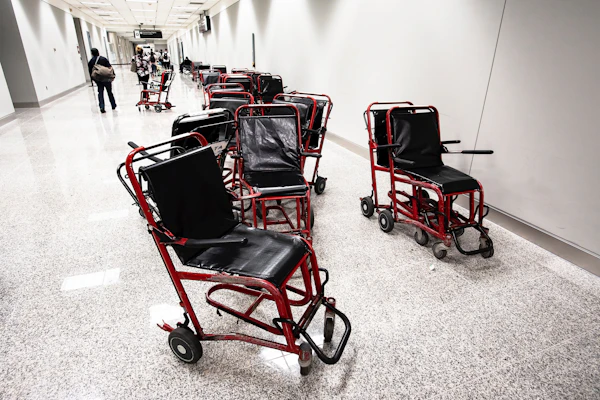
Here at Hireup, we keep a close eye on what’s happening in the disability community and we’ve noticed a disturbing trend. Lately, it feels like every week another horror story emerges from a traveller with disability who’s been treated badly by an airline. Having pulled together some examples that have recently aired on social media - and sometimes, have gone on to be reported by mainstream news - it seems that feeling is spot-on.
This week, the disability advocate responsible for changing Beyonce’s tune took to Twitter to help a family in need. A young girl called Willow, who has cerebral palsy, had been travelling with her parents on a Qantas flight from Melbourne to Sydney, during which time the airline misplaced Willow’s specialised pram.
Hannah Diviney, who also has cerebral palsy, delivered this message to the airline: “This lovely munchkin Willow who has CP & her lovely parents were on your flight QF498 from Melb to Sydney last night and they’ve lost Willow’s specialised pram she needs to be properly supported. We’d love your help to get it back.”
Within 13 hours, Hannah let her followers know that Qantas had located the pram and returned it, intact, to Willow and her family. A happy ending, to be sure, but one that is all too rare in similar stories about Australian airports and numerous airlines of late.
A “distressing” and “humiliating” experience
In May, former Australian Disability Discrimination Commissioner Graeme Innes had a “distressing” and “humiliating” experience at Adelaide airport. After his guide dog’s harness triggered the body scanner, he was separated from his dog and patted down.
Innes told ABC News that incidents like this happen to him once every three months. “I feel sick in the stomach every time I go to an airport,” he said. “Airports and airlines have to be brought in line and the only way to do that is to have people with disabilities involved in changing the regulations so we’re included, not treated as a separate group of people.”
“Surely there’s a way to fly an aeroplane with two wheelchairs on board.”
Also in May, disability rights campaigner Elly Desmarchelier told her Twitter followers she’d been kicked off a flight because there was already one electric wheelchair user travelling on the plane. As indicated by Qantas’ information on safety restrictions around mobility aids and wheelchairs, “there is generally a limit of one electric wheelchair per flight”.
“Found out at check-in I’d been pumped off my @Qantas flight b/c *shock horror* there was another electric wheelchair on our flight,” she wrote. “Manager, Eric, was great, but he shouldn’t have to cover for an outdated rule. Surely there’s a way to fly an airplane w/ 2 wheelchairs on board.”
“It was dehumanising.”
Again, in May, wheelchair user Akii Ngo said they were mishandled, mistreated and injured by Jetstar airline staff. According to Ngo, a trip home to Melbourne from modelling at Australian Fashion Week in Sydney required them to travel via Adelaide Airport, where Jetstar staff pushed them across the flight bridge in their airline aisle wheelchair. As Ngo told ABC News, “essentially they pushed me too hard, I fell right out of the chair”. Ngo said that airline staff told them they should have held on tighter. “I couldn’t get up — it was dehumanising."
“I can fly, but I can’t take my wheelchair.”
Come June, Paralympic swimmer Karni Liddell had shared an Instagram video saying: “I can fly, but I can’t take my wheelchair.” Liddell said she was denied access to a Jetstar flight because her wheelchair contains a lithium battery. She remarked to a staff member, “that’d be like me saying, ‘You can go but just take your legs off’". According to Liddell, the staff member responded with, “stop being rude”.
Airlines require a dangerous goods certificate for lithium batteries - which Liddell said she had, issued by both Qantas and Jetstar, but was told she needed to give five days’ notice and fill in additional documents to transport her wheelchair on the flight. “I can’t count the number of flights I have been kicked off or rejected from because of being in a chair having batteries,” said Liddell, whose story was covered by several news outlets including the Sydney Morning Herald.
“Australian airlines need to sort their shit out.”
In August, Australian of the Year Dylan Alcott was stranded on a landed plane while waiting for his wheelchair. As he tweeted to his following: “Left on ANOTHER PLANE without my wheelchair being brought to the gate. No idea where it is. Waiting for TOO LONG! Australian airlines need to sort their shit out. It is inhumane and unfair taking people's independence away and not caring about it.”
Kurt Fearnley, another Paralympian, once crawled through Brisbane airport rather than use an unsuitable wheelchair offered by Jetstar when he was forced to check in his personal wheelchair.
“I’ve been referred to as ‘the wheelchair’ instead of by my name.”
Also in August, actor and writer Jamila Main shared their story of being stranded overseas, without their wheelchair, for five days after it was lost in transit with Qatar airways.
Main posed the question in an opinion piece for Hireup: If there was a risk you would lose your legs due to air travel, would you fly?
“I’ve also not had great treatment in the past,” wrote Main. “When I’ve flown as a wheelchair user, I’ve been referred to as ‘the wheelchair’ instead of by my name. I’ve been left by airline staff in empty corridors without explanation or knowing when to expect them to come back for me.”
“Qantas broke my wheelchair and won’t fix it.”
Just last week, Zoe Simmons’ shared the story of her wheelchair being damaged when she took a Qantas flight from Sydney to Canberra.
As Simmons wrote for news.com.au, when she initially reached out to Qantas for help, “they told me they wouldn’t repair my wheelchair or reimburse me for damages".
"‘Thank you for taking the time to contact us about your wheelchair’, their customer care team wrote in an email, after I lodged my damaged property report. ‘Airlines do not accept liability for minor damage to the brakes, wheels and handles of your wheelchair. Therefore, I am unable to offer you any financial settlement in this matter’,” Simmons wrote.
According to Simmons, after her Twitter post was shared thousands of times, Qantas changed their tune and paid for the damage to her wheelchair.
Much like that of young Willow and her lost pram, this story had a happy ending. But not everyone has access to high-profile disability advocates or a large social media following. And with so many cases of mistreatment hitting the headlines, one can only wonder - with dread - how many are going unheard.
Have you been mistreated while travelling? We want to hear you story. Get in touch with our team at communications@hireup.com.au

Melanie Dimmitt
Melanie Dimmitt is a freelance journalist, author and broadcaster. Since her debut book, Special, was published by Ventura Press in 2019, Melanie has written, spoken, podcasted and advocated far and wide for disability families. Creator and host of the award-winning NDIS Know-how and Tubie Talks podcasts, Melanie also publishes an annual magazine, The Blend, for the tube-feeding community.