
Neena Bhandari investigates the cultural divide that’s locking Australia’s First Peoples out of key supports.
For most Aboriginal and Torres Strait Islander people with disability, the NDIS remains riddled with hurdles that make getting on to the scheme and navigating it difficult.
That’s according to Indigenous disability service providers, including Shanelle Beazley, sector development coordinator at Kurranulla Aboriginal Corporation.
Beazley says the NDIS requires sufficient evidence to be satisfied the person needs support. For most Indigenous people, getting that evidence is the most challenging part of navigating this scheme.
“Most Aboriginal families have sufficient paperwork acknowledging their disability, such as autism or psycho-social disabilities like bi-polar or schizophrenia,” Beazley says, “but they lack documentation detailing its impact on their everyday lives to satisfy the NDIS.
“This requires a psychologist, for example, to write a functional capacity assessment or similar [for psycho-social disabilities], which can cost upward of $1500.”
Beazley says another barrier to accessing appropriate funding is time.
“To get a diagnosis, Aboriginal people in regional and remote NSW have long wait periods simply to see an occupational therapist. The waiting period is more than six months in the public system. It’s even longer for regional and remote areas.”
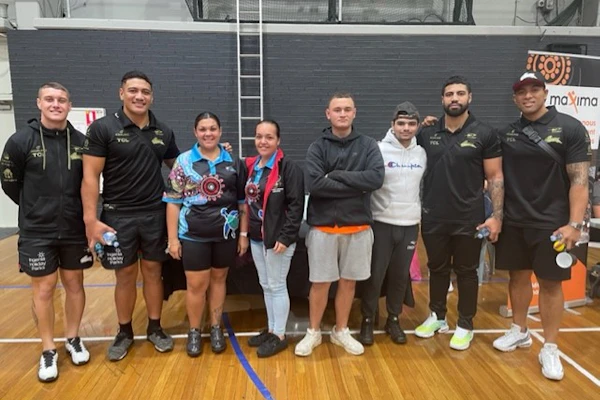
Image: Kurranulla Aboriginal Corporation NDIS youth group clients.
Beazley says she’s experienced this problem through her work in the disability sector, and also on a personal level. In fact, she says the design of the NDIS has left out a crucial part of indigenous culture. Family.
She says, “The NDIS is designed to support individuals rather than families, and this concept simply does not suit the values and needs of Aboriginal and Torres Strait Islander people.”
Beazley says the only way to improve Indigenous peoples’ access to, and use of, NDIS funding is to have culturally appropriate providers assist them in better understanding the scheme’s purpose and in providing them a pathway to the scheme.
“When Aboriginal people are being supported by Aboriginal providers to access the NDIS, they are able to explain the process, help them understand how their needs can be met and supported, and include them in the decision making.
“But when it is a non-Aboriginal provider, Aboriginal families lack trust and [are reluctant to build] a rapport with these providers due to historical government policies,” says Beazley.
While supporting families with children, she has found that they are apprehensive to discuss the role of a parent and providers in supporting their children’s developmental and other needs.
“Parents fear giving information that would somehow potentially reflect on their ability to parent rather than the needs of a child with a disability. This is often a huge barrier and results in the outcome of the NDIS plan not necessarily reflecting the needs of the child,” she adds.
Indigenous service providers say the NDIS must work in collaboration with mainstream services, such as health, housing, transport and education, to help enhance the quality of life for Aboriginal and Torres Strait Islander people with disabilities.

Neena Bhandari
Neena Bhandari is a an award-winning journalist and foreign correspondent. She writes for various international and national media outlets on a wide range of subjects, including health and science, disability and the NDIS. She has lived experience of polio and has written extensively on poliomyelitis and post-polio syndrome/late effects of polio, including for the British Medical Journal. Through her writings, she hopes to bring the focus on disability issues from the margins to mainstream media.