
What started as a Twitter debate sparked by an article on Hireup news has opened up a discussion between disability advocates Carly Findlay and Lisa Grech, a duo with conflicting beliefs on who can share experiences of disability.
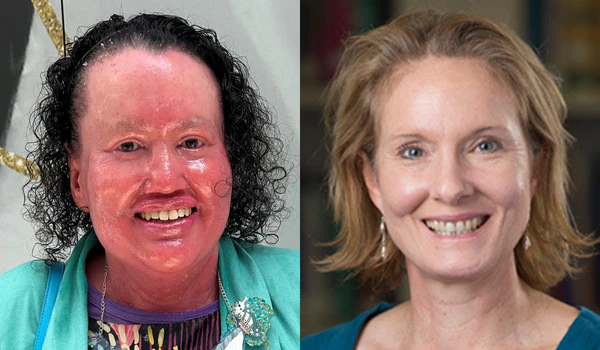
In late February, Hireup published an article by Mandy Hose about her positive experience of accessibility at a Harry Styles concert in Melbourne, which she attended with her disabled teen. Others at the concert had had bad experiences: people with disability refused access to a sensory room or treated badly by staff. We’d published a separate piece on that by disability advocate Zoe Simmons, who has disability.
On Twitter, the article by Mandy Hose caused much debate. Should she – a non-disabled woman - have been given a platform to speak on an issue of most significance to people with disability?
Advocate Carly Findlay and academic Lisa Grech were at the heart of the Twitter conversation with the following conversation:
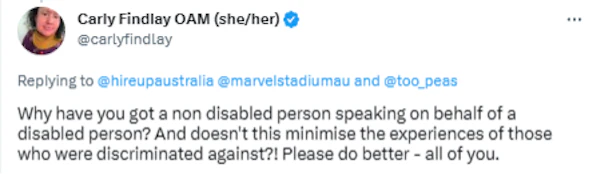
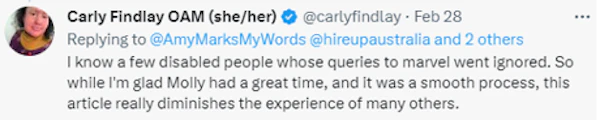


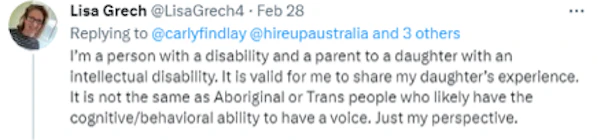

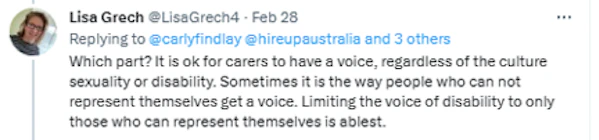


At Hireup, we thought their conversation got to the heart of a really important issue. Who has the right to talk about the issues facing people with disability? So – off Twitter - we asked Carly and Lisa to start a dialogue. Carly went first . . .
***
Dear Lisa,
What got me fired up was seeing the article had been written by the parent of a disabled teenager. I wished the teen had got to tell the story herself. And, as you saw on Twitter, I wasn’t alone.
As a disabled person, working in the arts and media, I am passionate about disability-led art and media. “Nothing about us without us.” I never saw anyone like me in the media when I grew up. As an adult, I’ve seen how exploitative the media is and how it’s often not led by disabled people.
I’ve helped change that through my work as a writer, speaker, activist and arts worker. I believe disabled people should be facilitated to tell our stories - in whatever medium we can. I am not "a voice of the voiceless", as people sometimes tell me. I am helping disabled people tell our stories to wide audiences.
I’ve shown how it can be done. At Melbourne Fringe, I work with Deaf and disabled artists to make their shows accessible and deliver panel programs discussing access and inclusion to the arts sector. Last December, I programmed an event led by intellectually disabled artists. They discussed the successes and challenges they've experienced. They were supported by arts workers and parents, and I provided lots of easy read information in and we met on Zoom to rehearse. The artists felt so empowered and it was very well received.
Disabled people can be helped to speak for ourselves. It can be done!
* * *
Dear Carly,
I’m a longtime follower of you on Twitter and appreciate your disability advocacy. You continually improve societal acceptance of disability and improve equality with your voice.
But mine is a legitimate voice too. My daughter has a severe intellectual disability and expressive language disorder, requiring full-time supervision. I have spent a lot of time with people with disabilities and their parents. I also have multiple sclerosis and chronic depression, so have my own disabilities.
Some people with disabilities, like my daughter, do not have the language or intellectual capacity to tell their story, even when assisted. Can her story be told through my eyes – or should it not be told at all? Even when an intellectual disability is less severe, a person may need support to communicate the nuances of their experience, due to reduced language or intellectual capacity.
Discrediting the voice of parents/carers of people with disabilities biases media reporting because only the experiences of those who can convey their message are reported. Whole groups of people with disabilities are excluded when that happens.
In the article that that sparked our Twitter discussion, it wasn’t clear whether Molly can tell her own story without assistance from her mum. But even if she was able to, why doesn’t Molly’s mum have the right to tell the experience from her perspective? It was clear that she was involved in booking and attending the event and derived great joy from her daughter’s experience. “Nothing about us without us” is inclusive of the carer experience too – especially when the voice of a person with a disability wouldn’t otherwise be heard at all.
* * *
Dear Lisa,
Thank you for your kind words and considerate letter. You are clearly a dedicated disability advocate and ally.
You're absolutely right – parents of disabled children have a valid story too. But that's not the disabled experience. I'm not saying parents shouldn't have a voice, I'm asking that parent voices aren't centred in stories about disabled people, and that parents consider how they convey their story, and that disabled children and adults can consent to media about them.
For too long stories about disability have been told by non-disabled people. These stories are often tragic, pitiful, inspiration porn, littered with disability euphemisms and over-sharing. They often express grief and regret, which not only harm the disabled subjects of the media and art but also the wider disability community. However, I am seeing more and more non-disabled parents look to disabled adults (and young people) as mentors, to help them understand and shift the narrative to centre disabled people, including their children. It's heartening, because their disabled children will become disabled adults, and are a part of the disability community.
I edited Growing Up Disabled in Australia - an anthology featuring 46 disabled people sharing stories in written essays, poetry, interviews and illustration. I worked with Yorta Yorta woman Jane Rosengrave, who has an intellectual disability and was raised in institutions, to tell her story. I interviewed her in depth, and ensured she was supported with a social worker present. Jane has gone on to speak at numerous events about Growing Up Disabled in Australia. I am proud to have amplified her voice. There is a place for both disabled people and parents - but disabled people's voices should be prioritised and facilitated.
Best, Carly
* * *
Hi again Carly,
I agree that people with disabilities should be front and centre of their own stories, where possible. I also agree that the media often sensationalise tragedy or holds people with disabilities up as inspirations just for ‘getting out of bed’, as famously highlighted by the (dare I say…) ‘inspirational’ and very funny, late Stella Young.
However, we differ with respect to people who don’t have capacity to tell their story or consent to it being told. My daughter is an example. Her intellectual disability is severe, so she doesn’t have capacity to share her life and experiences. I’m not sure she realises she has a disability or is different, to be honest. She is just a very happy person who loves life. Behind the scenes lots goes into coordinating her life and making decisions on her behalf, keep her safe and provide her with opportunities.
For us, then, the experience of the person with a disability and the parent is shared. It is a different experience to parents of children, including those with disabilities, who gain greater capacity and independence with age. I don’t think there is another person with a disability who is a better representative of my daughter’s experience than me. “Nothing about us without us” is true of the parent-child experience for people with severe intellectual or behavioural disabilities. My situation isn’t unique, it is common to the many parents who are dedicated to their children with severe disabilities, who love and gain immense joy (and experience many challenges) from their parental role.
It is challenging to hear people with disabilities who have greater capacity and autonomy over their lives, and have not walked in our shoes, discredit voices of parents who speak on behalf of their loved ones. We are on same team as people with disabilities more broadly.
We may not always agree, but I’m glad we can keep this conversation open, so we continue to learn from and understand each other.
With respect,
Lisa
* * *
Carly Findlay OAM is a writer, speaker, appearance activist and arts worker. She's also a rollerskater, lifelong Darren Hayes fan and has never met a cheese she didn't like.
Dr Lisa Grech is a researcher and psychologist, as well as proud mum to her beautiful daughter, Hannah. Lisa is passionate about improving the lives of people with severe and chronic health conditions through healthcare focused research, as well as to issues related to equity and diversity more broadly.