
The new minister's first big interview with David Speers was an illuminating discussion.
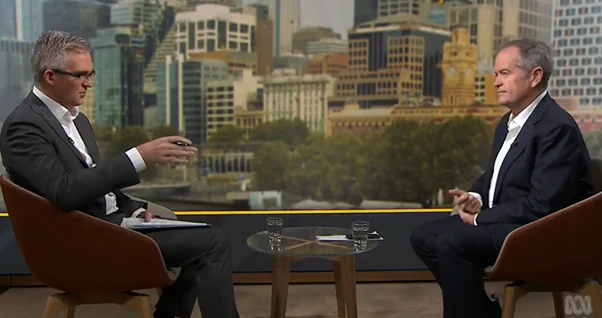
It was his first big television interview as Minister for the NDIS, a moment to make clear his broad intentions for transforming the scheme, and improving the lives of people with disability.
On ABC’s Insiders, under impressively forensic examination by David Speers, Bill Shorten addressed fraud in the scheme, issues around unregistered providers and how the NDIS workers are treated. There was lots to absorb.
The scheme, Shorten began, is “no longer the original dream". There’s waste, there’s criminal fraud, there’s ‘red tape’ and a ‘bureaucratic nightmare’.
Trust in the NDIS had been lost and needed to be "restored".
Shorten summed up his contempt for the way the previous, Liberal, government had treated the scheme by saying they’d put a “padlock [against participants] coming into the scheme” but “left a welcome mat at the back door [for unscrupulous people, including outright fraudsters, making money from the scheme]”.
But the substance of the discussion began with pricing. Prices were set, said Shorten, ‘in a black box [with] no transparency.'
“The only way the NDIS can fulfil its potential is by involving people with disability in the co-design of the scheme”. The government, said the minister, will ‘bring forward’ a ‘ten year review’ of the scheme that had, previously, been due to start in June 2023. Top of the list will be to examine ‘the NDIS mark-up’, why people with disability are often charged more than others simply because the NDIS is paying the bill.
“I am putting on notice that we want to have a pricing system which makes sense to everyday people” said the minister.
Shorten was also honest about the limits of the NDIS. It shouldn’t be “the only lifeboat in the ocean for Australians who live with disability. . . It’s aimed for the most profoundly impaired and severely disabled Australians’. There are things it can’t, and shouldn’t do. But for that, he said, there can’t be a “wasteland” for people with disabilities who aren’t on the NDIS.
“The NDIS was never meant to be the only way which we give people with disability and their carers [help]. . . All Australians, if they have an impairment, [should] get a fair crack at things.”

David Speers asked about the explosion of unregistered providers in the system. Registered providers are overseen by the Quality and Safeguards Commission, their workers have minimum levels of training, they are audited each year. None of that applies to the unregistered.
“[So] perhaps unsurprisingly 90% of providers are now unregistered. So is that something you’re going to look at?”

“Yes” said the minister. “we will look at that question”. Shorten said there had been an “explosion in the market for disability services”. Some people opt to register. Some don’t.
Should all be registered, pushed Speers, or have – at a minimum – a police check?
For “personal care services” replied Shorten, “there has to be a minimum level of competence, quality and you have to be paid the proper award”.
Shorten doesn’t think everyone being paid with NDIS funds needs the same level of registration or oversight. “If you’re cutting someone’s grass you don’t need to go through the same sort of check as if you’re providing care services.” But he said “personal care” providers, particularly, need greater scrutiny.
“Taxpayers want to make sure they have a line of sight that what’s promised is delivered [while also removing] some of the red tape so that recipients have control”.
On the workforce, Speers asked about the gig economy,
“There are often unregistered providers working for platforms - like gig economy workers - and they are not necessarily treated like employees, they aren’t paid a minimum wage, superannuation, penalty rates. . . are you going to put an end to that?”
“The internet has been invented” replied Shorten. “We’re not going to put away the gig economy. But I want to make sure that when someone is employed through an internet platform that they’re paid properly.”
The interview concluded with a discussion about overall cost of the NDIS to the taxpayer, and the costs for participants – in money and time - to get on the scheme and stay on it.
The NDIS was not supposed to create, as Shorten put it, ‘second full-time job[s]’ to access “just modest payments”, nor – in Speers' phrase – “lawyers at ten paces” as participants appeal cuts to their plans and the government pushes back. Shorten said he’d be meeting with lawyers for participants to hear about the “absolute stupidities you’re currently seeing from the Commonwealth in the way they do their litigation.” The government employing ‘top-end-of-town law firms’ to fight participants, he said, "is not the way an empathetic scheme should be run.”
The discussion ended, refreshingly, with a look at the economic benefits – as well as the economic costs – of the scheme. Shorten raised the analysis by Per Capita that, for every dollar spend on the scheme, $2.25 is generated in economic outcome.
“We should stop . . . [looking only at] every cost of input [and start looking at] quality of outcomes”.
Reaction to the interview was swift. In the studio immediately afterwards Insiders regular Patricia Karvelas told David Speers the interview was “excellent”.