
It’s not every day that you get to meet a garden gnome called Cabbages. Dwayne Fernandes politely introduced me to this character while detailing the benefits of Minds at Play, a social gaming program that he co-founded with fellow Dungeons & Dragons enthusiasts, Dan Papallo and Jeff Ozog.
“Cabbages is a complete larrikin,” chuckles Dwayne, holding the “mini” figurine alongside a decidedly larger and fiercer “dragonborn” character, for comparison.
Dungeons & Dragons - D&D to its millions of devotees - is a fantasy role-playing game that’s been around since the ’70s. Usually played in groups of four to six, players create their own characters and are guided through other-worldly scenarios by a Dungeon Master. It’s a game that relies on self-awareness and, as a growing body of evidence suggests, helps build social skills for those who are neurodivergent.
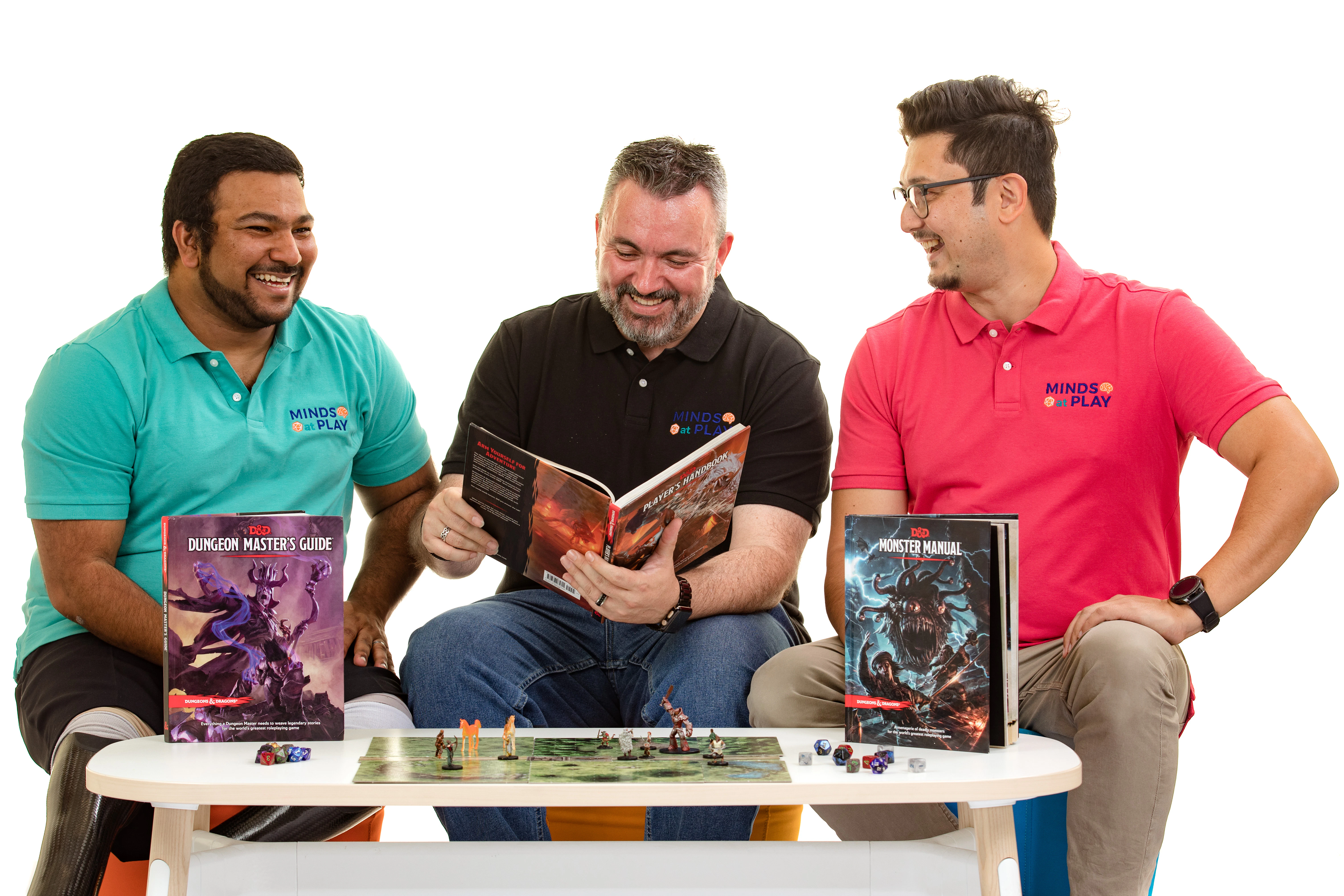
Image: The Minds at Play team rolled the dice and didn't foresee the benefits their program would have.
“D&D is about dice rolls and how we make things happen,” says Dwayne who, as a double-amputee and world record-holding tower climber, is an adventurer both on and off the job. “You use your characters as a way of being who you want to be - or who you hope to be - and if your character goes through some challenging things, you’ll learn some lessons.”
Traditionally speaking, D&D is played around a table. But at the onset of the pandemic, when many NDIS-funded social groups were forced to hit pause, Dwayne, Dan and Jeff saw an opportunity to host virtual D&D games via Zoom, in what would become their Minds at Play program.
Minds at Play follows the standard D&D rules, but has added “bespoke adventures” to steer participants into opportunities for learning. “All our Dungeon Masters are following our storyline outlines and whatever happens with the players’ interactions is what we flow with,” says Dwayne.
“When a player makes a decision, that decision is praised or punished depending on what type of behaviour is being exhibited. If a character charges in when they’re not supposed to, we can show them the consequences of that and they learn a better way of engaging.”
Dwayne, who works in diversity and inclusion for the NSW government, has a godchild on the autism spectrum and says they’re “going to need help to land a job.”
“We know the turnover rate in employment for our community is double the rate of the general population,” he says. “You need basic social skills to retain a gig, so this business came out of that space.”
After plotting out a pilot program and pitching it around the sector, the autism-focused Luke Priddis Foundation took a punt.
“They sent four people to us - we call them our OG players - and they played with us for a year,” says Dwayne. “After the first two hours of playing D&D with us, they created their own Discord server [chat room]. The support worker accompanying the group told me, ‘these boys have been to multiple events together, but don’t talk to each other. I’ve never seen this happen before’.”
At the time, Dwayne and his co-founders hadn’t foreseen the large potential of this program. “Now we see it,” he says. “We’re starting to get reviews from parents who are saying things like, ‘I’ve never seen my kid smile, laugh, or heard them making noise in the other room. This is awesome to see happening in my house. It’s an outlet that allows them to make friends’.”
Minds at Play now hosts more than 80 players, between the ages of seven and 47, and holds gaming groups during each school term. They also introduced Minecraft, a world-building video game, to the mix. “We’ve been doing a lot of storytelling, teamwork, collaboration, roleplaying and having a ball of a time,” says Dwayne, who recently met up with two of the “OG” players offline.
“One of them told me, ‘I can hold down a retail frontline job’. He tells me it’s super easy holding on to this frontline retail job because he’s having far more complex conversations with us during D&D.”
The other OG player maintained eye contact with Dwayne throughout their conversation. “When I asked, ‘how are you managing this?' They said, ‘oh, it’s very easy. I’m imagining a Zoom frame around your face’.”
As Dwayne says, Minds at Play participants are learning how to be more social in the real world. His message for those who are interested in giving the program a try is: “Jump on our website, register, and we’ll see you soon.”
For more information about the Minds at Play program, visit the Minds at Play website.

Melanie Dimmitt
Melanie Dimmitt is a freelance journalist, author and broadcaster. Since her debut book, Special, was published by Ventura Press in 2019, Melanie has written, spoken, podcasted and advocated far and wide for disability families. Creator and host of the award-winning NDIS Know-how and Tubie Talks podcasts, Melanie also publishes an annual magazine, The Blend, for the tube-feeding community.