
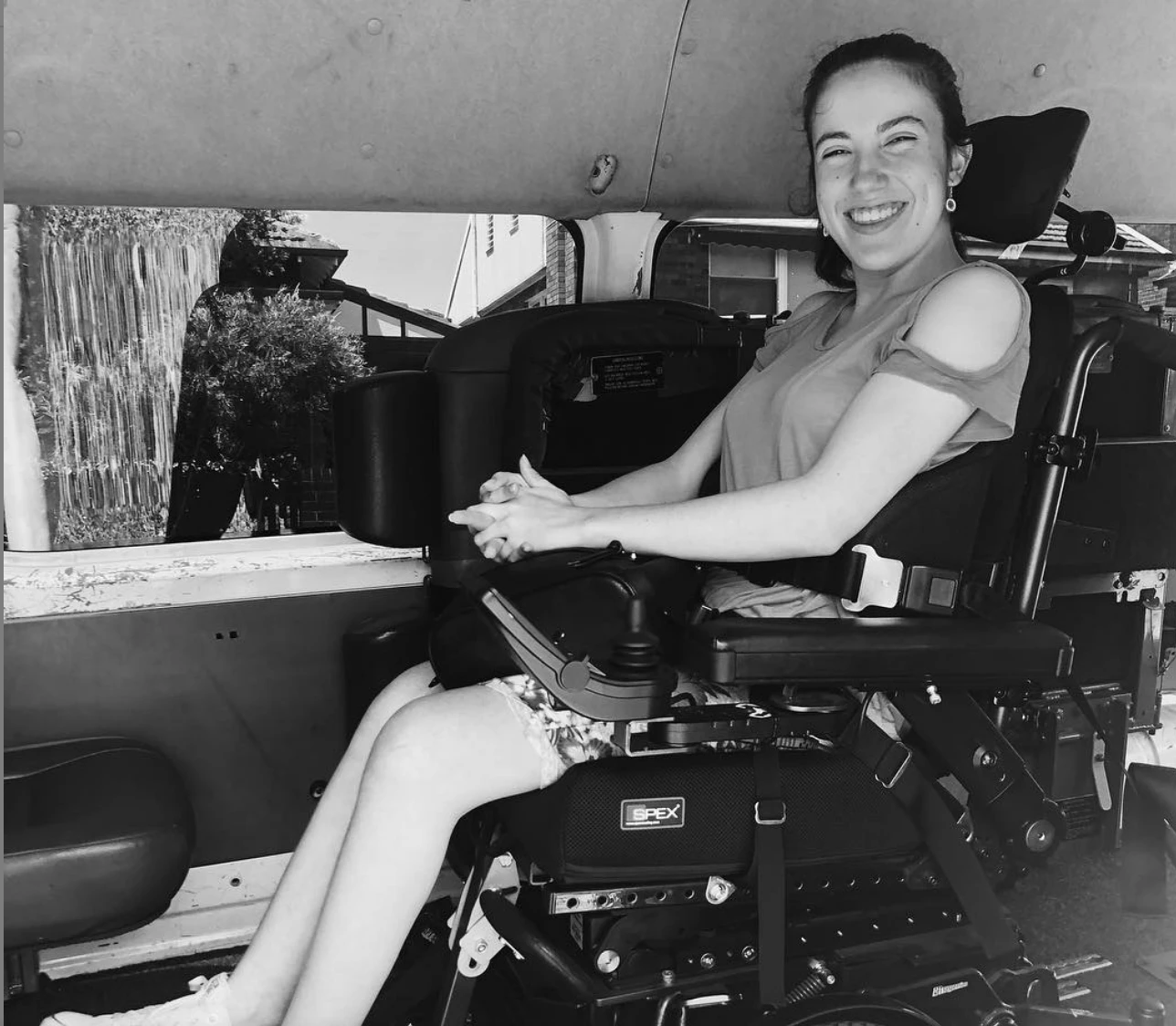
Growing up, I was the kind of kid who believed in fairies and magic, who loved nothing more than getting lost in the pages of a book or in the world of a film. I think it helped me process the strange ‘otherness’ that seemed to pervade my life as someone with a disability. I have Cerebral Palsy (CP for short) which is a movement disorder that affects my fine and gross motor skills; everything from walking and balancing to being able to use a knife and fork or having neat handwriting. At this stage, there’s no known cure or direct cause. It’s something that I will live with for my entire life.
The worlds I escaped to most often as a young kid were the ones of Disney films and books. They helped me learn to read and understand how storytelling works, something that was important to me even then. I’d already decided at the grand old age of four that I wanted to be a writer. I’d get lost in the colours and songs, absorbing many of the subtle life lessons like a sponge. But there was always something missing…
None of the books I read, TV shows and movies I watched or games I played had anyone in them who looked and lived like me. And to be clear, that was not exclusively a Disney issue but a standard practice across the board for all children’s media at the time. It says a lot about how desperate I was to feel connected to the worlds that the Disney characters I related to most, then and now, were living in. The worlds of: Belle, Ariel, Tigger and The Beast.
Belle is probably the simplest to explain because she was obsessed with books and found the same escapism I did, but also had broader plans for her life than society did. Ariel just wanted to belong and feel part of something more. Tigger thought of himself as “the only one,” which while not strictly true for disabled kids, speaks to a lot of the isolation and otherness we feel thanks to the constant cycles of specialist doctor’s appointments, pain, various therapies, surgery and everything else that you do to keep on top of your disability. The Beast draws the most painful parallels because he thought of himself as ugly, a monster, someone driven to keeping himself away because people didn’t understand him and couldn’t see past his physical differences.
For years now, I’ve dreamed of seeing a disabled Disney princess, because I think the princesses as characters have so much reach and are so readily embraced by pop culture that the impact would be momentously positive. On one hand, it would give millions of children the opportunity to see themselves at the centre of a grand adventure, full of friendship and love. On the other, able-bodied kids watching a character like this would go a long way towards building tolerance and empathy, as well as breaking down the fear of the unknown.
In one way or another, I’ve been actively campaigning for this since 2015, when I wrote the first of several open letters to the Disney Company. To this day I haven’t received a reply or recognition that I sent them at all. More recently, my campaigning has kicked up a couple of notches with a wildly successful petition on Change.org that has over 30,000 signatures from around the world. Unfortunately there isn’t a magic number at which Disney has to start paying me attention, but I figure the more signatures I get and the more noise I make, the harder I’ll be to ignore.
So, this International Women’s Day, make my voice louder by signing and sharing my petition! Thank you for your support.
As part of International Women's Day, discover why cultures need to change.
Hannah Diviney is a writer, disability advocate and pop culture fanatic living in Sydney, Australia. You can follow her adventures on Instagram @hannahthewildflower and on Twitter @hannah_diviney

Hannah Diviney
Hannah Diviney is a writer and disability advocate from Sydney, Australia. She's also the Editor-in-Chief of Missing Perspectives. You can follow Hannah's adventures on Instagram and Twitter.