
Journalist Briana Blackett has two autistic sons on the NDIS. Here, she shares why media coverage of autism and the scheme can be hard to take and misses the point.
I always brace myself when I hear the words autism and the National Disability Insurance Scheme (NDIS) used in the same sentence by mainstream media.
I know it’s probably not going to be pretty. The words will typically be delivered by someone not directly impacted by autism who’ll focus on how much autistic people ‘cost’ and how it's ‘threatening’ the viability of the scheme. In most stories about the ‘sustainability’ of the NDIS, you’ll almost always find a reference to autism. It’s likely the only disability to be specifically mentioned.
This narrative frames autistic people, and their families, like mine, as being a problem. There's a whiff of ‘victim blaming’ about this approach that, quite frankly, hurts. So, when The Australian published a series of articles about autism and the NDIS recently, my first thought was to not read them. But, being a journalist who writes in the disability space, I put on my big girl pants and clicked on the links.
The usual lines were there - sustainability… autism… problem. But they also dived a little deeper and looked at whether people - kids, mostly - were being wrongly diagnosed with autism, or a higher ‘severity’ level so that they could access NDIS funds. I can’t personally speak to this, although I do know from experience that getting a diagnosis is not a simple process.
However, I can see why people might worry that, without a diagnosis - especially a ‘severe’ one - they or their child might not get the help they need. That’s because autism can impact any - or every - part of a person’s life which, without the right support, can take a toll on them and their families.
Autism is referred to as a spectrum because, like humanity itself, the condition is vast and varied. How it impacts one person can be hugely different from the way it impacts another. And for each individual with autism, there are strengths and weaknesses that can change depending on all sorts of factors; the sensory environment, communication methods, unexpected changes to rules or plans. At least, that’s how it presents in my kids.
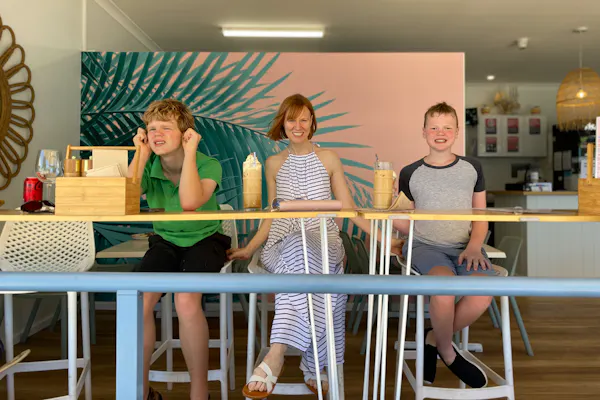
When my two sons were diagnosed as toddlers, there was no NDIS. I cashed everything in (including my retirement savings) to pay for their therapies and other supports. I completely understand the financial impact of an autism diagnosis, and I also know what it’s like to be pauperised due to the high costs of supporting my disabled children.
In its report Caring Costs Us, Carer’s Australia highlights the financial impact of caring on long-term carers like me. We typically lose “at least $940,000 in lifetime income, and $444,500 in superannuation”. And for people with disability, like my kids, the prospect of living on or below the poverty line is almost twice as high as their non-disabled peers. So, being able to access a scheme that lessens the financial impact of disability is very important.
This is why the NDIS is crucial but, since its inception, it has become the “only lifeboat in the ocean” for many in the autism and disability community. It wasn’t supposed to be this way. In fact, when NDIS minister, Bill Shorten, said those now oft-quoted words, he said the scheme shouldn’t be the only “lifeboat” - that is, the only support system for people with disability.
He’s right, but at the moment it’s pretty much all we’ve got. And it means people and their families needing any kind of disability support are all swimming toward that same single lifeboat. It seems to me the problem isn’t the number of autistic people, it’s the number of lifeboats. There can’t just be one. We simply need more.
As Nicole Rogerson from Autism Awareness Australia told me, “all Australians with a disability need and deserve to have funding and supports to help them live their best lives. The NDIS, however, was not designed to fulfil all of these needs.”
Rogerson goes on to say, “other government funded programs need to be implemented to provide a broader spectrum of supports across education, disability, and healthcare for all Australians with a disability.”
You’d be hard pressed to find someone who doesn't think this is the crux of the problem, and yet it’s never in the headlines. Instead, the narrative is often about autism itself and not the inaccessible world autistic people live in.
Let’s remember this when we report on the incredible and complex creation that is the NDIS. Singling out a particular disability for a catchy headline or an easy blame game won’t make the scheme more sustainable, but it will deepen the stigma felt by those who need it.

Briana Blackett
Briana Blackett is a journalist and advocate for her two children with disability. After more than 20 years in TV news, she now works for Hireup as part of its Communications and Advocacy team.