
Aboriginal and Torres Strait Islander people are twice as likely to experience disability, and more likely to experience increased barriers to accessing disability supports compared to non-indigenous Australians.
Journalist Neena Bhandari chats with Indigenous service providers who share the many challenges they face in delivering disability supports to communities living outside of the major cities.
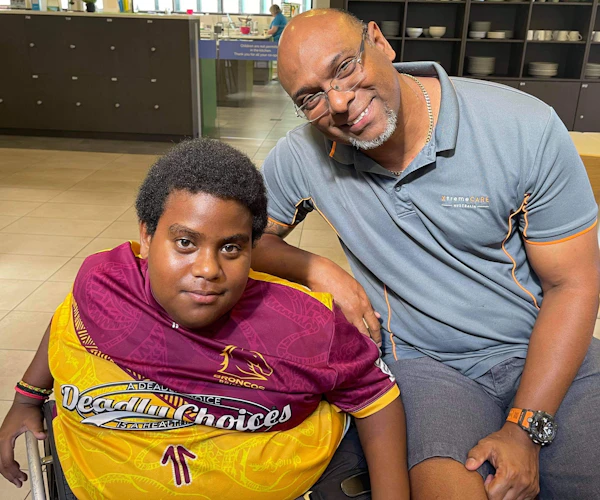
Image: William Tatipata, co-founder and owner of XtremeCARE Australia, sits with Charlie Kris, an NDIS participant, on Thursday Island, Torres Strait.
“Many people in rural and remote Indigenous communities still do not know about the National Disability Insurance Scheme (NDIS) and its role and functions in disability care,” says William Tatipata, Managing Director of Xtremecare Australia, an Aboriginal and Torres Strait Islander disability service. “We begin with making them aware of the scheme [how to apply and obtain a disability assessment] and then educating them on the supports and services the scheme offers.”
Tatipata says, “Our people are confused about what services and supports are covered by ‘health’ and what falls under the NDIS. If a diabetic person requires a new diabetes monitor, for example, it is covered by ‘health’. But if the participant’s motor skills are impaired, the NDIS will fund the monitor following a functionality assessment by an occupational therapist.”
Forty-four per cent of Indigenous Australians live in regional areas and 21 per cent live in remote areas. In Queensland alone, 70 per cent of Indigenous people live in regional and remote areas, according to an Australian Bureau of Statistics’ survey.
Recent research indicates that Indigenous peoples’ engagement with disability supports may be enhanced through better cultural awareness.
“We don’t look at a participant’s disability in isolation. We have to factor in the cultural, environmental and lifestyle aspects while delivering services in Indigenous communities”, says Tatipata.
He also says, even when these factors are considered, it’s hard for people to access supports due to their remote locations.
“Some Indigenous participants in rural and remote communities have good plans, but there is a lack of allied health services, infrastructure and workforce to deliver them so the dollars in their individual plans have been lying unutilised,” he adds.
It’s a problem highlighted in an issues paper by the Disability Royal Commission, which cited the Northern Territory as an example. A submission from the NT Disability Advocacy Collective reported 44 per cent of NDIS plans in remote parts of the territory are underutilised.
Tatipata says distance, and the scarcity of services, is a real problem.
“There are hardly any independent allied health service providers in the Torres Strait or Cape York areas so participants have to fly to Cairns or depend on Queensland Health sites, which prioritises its own patients over NDIS participants.”
Ninety per cent of the services in these rural and remote areas are a mixed model of telehealth and fly-in-fly-out, face-to-face consultation every few months.
“It is about a two-hour flight from Cairns to Weipa, the largest town in the Cape York Peninsula, or Horn Island in the Torres Strait. To make service delivery cost-effective, we have adopted a cluster approach. Every four to six weeks, we fly allied health professionals – occupational therapists, physiotherapists or speech pathologists – into the community from Cairns and split their transport and accommodation cost between the number of participants availing their services”, says Tatipata.
Similarly, any equipment requiring a service or repairs has to be brought to Cairns.
“We need robust equipment suited for our environment and we need to build a skilled workforce to maintain and service this equipment close to where the participants reside.
“In the early days of the NDIS roll out, participants were given power wheelchairs in communities with no paved pathways or ramps and the housing was not designed to accommodate the equipment. So, the equipment was rendered useless”, he adds.
Xtremecare Australia services remote communities along Australia’s eastern seaboard, from the Torres Strait Islands in the north to Victoria in the south.

Neena Bhandari
Neena Bhandari is a an award-winning journalist and foreign correspondent. She writes for various international and national media outlets on a wide range of subjects, including health and science, disability and the NDIS. She has lived experience of polio and has written extensively on poliomyelitis and post-polio syndrome/late effects of polio, including for the British Medical Journal. Through her writings, she hopes to bring the focus on disability issues from the margins to mainstream media.