
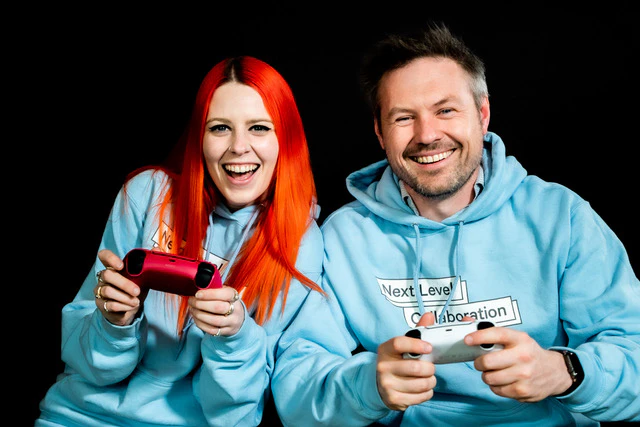
This story starts with two gamers.
Jess Rowlings, a neurodivergent speech and language pathologist, had just begun as a researcher at the University of Melbourne. When Jess discovered there was a guy in her department with a Super Nintendo in his office, she thought she had better meet him. That guy was Dr Matt Harrison, a senior lecturer and researcher in autism inclusion with a PhD in digital games-based intervention.
So began the creative union that sparked Next Level Collaboration, a neurodiverse-positive social capacity building program for kids aged 8-15.
How does it work? Across eight weeks, participants attend weekly sessions and play carefully selected video games in collaboration with peers. Jess and Matt actively recruit employees with neurodiversity, so there’s at least one staff member with lived experience in every session they run.
A year on from launching, Next Level Collaboration is expanding from four to eight locations across Melbourne. An online version is in the pipeline too, meaning kids all across the country can log on and learn.
Hireup speaks to Jess and Matt about why the gaming program is making winners of all its players.
What compelled you to build this program together?
Matt: I'm a teacher by trade and I was working with a group of kids in my school who were at risk of being disengaged. I started using gaming as a way to bring them together and to teach some collaborative skills. And I noticed that they could do things in the context of playing games with me at lunchtime gaming club that they couldn't do during PE or a science class.
I really wanted to find out what it was about the conditions that were created through game play that allowed these kids to perform these skills that they weren't bringing to other contexts. My PhD thesis examined how cooperative video games can be used as spaces for developing social capabilities for students with disability and neurological differences - and I wanted to do something with that PhD, I didn't want it to just sit on the shelf, gathering dust.
Jess: When I was in my master's years, especially, I worked with a whole range of different kids. And I was working with one boy who was about 13. He was fairly disengaged with the sessions, and then I found that his favourite game in the world is Dark Souls. I took that as an opportunity to refocus all the activities we were doing on his interest in Dark Souls.
For conversational skills, I said, right, I want you to sit me down and we're going to have a conversation where you're going to teach me what I need to do to beat this boss in Dark Souls. And his engagement and his interest in the sessions from that point on was just so different.
And at the end of the block of sessions he said, “I didn't really hate coming here”. I thought that was the highest form of praise I'd ever get. For me, that kid was such a point of career development. I could see the power of having someone’s strength and an interest involved in the activities - how much more invested he was in doing anything when it was relevant to him.

This leads us nicely to the ‘strengths-based approach’ baked into your program. Tell me what this looks like in practice…
Jess: So what we do is based on strengths and an interest in gaming - and we’re also really neurodiverse positive. For these kids, gaming is a point of strength. They've got a huge vocabulary about the games that they love and they want to tell everyone about it. They love telling me when I’m wrong about things in games. So we harness that and use a neurodiverse positive approach, as well.
We really don’t mind how the kids are showing their skills because we know that everybody shows them differently. Some of the kids need to wriggle, some of them need to jump up. Some might want to fidget or sit on their chairs upside down. And that's okay. Everyone does it differently.
What we want to do is get these kids really confident and really strong in their skills, in whatever way is most comfortable for them, without trying to change who they are.
Matt: It's a bit of a paradigm shift from the traditional model of therapy where you're trying to make everyone culturally homogenous and the same. And I think that's a historical knock against social skills programs and it's why a lot of the autistic community, in particular, have become very wary of social skills programs. Because they see it as trying to, I hate to say it and put this in quotation marks, “fix broken children”'.
We're not about that. We celebrate the diversity of people's brains. In fact, we want to empower the community to actually run the programs.
When you started the program, what did you learn from the first bunch of kids who went through it?
Jess: That we know a lot less about games than we thought we did! The first session was a learning experience into the massive diversity of the kids that we're working with. They all have very different needs and that's totally okay. For us it was a lesson in, how do we best support everyone in this room?
What changes did you make in order to do this?
Jess: We have some kids who need extra processing time and kids who find that they really need structure so they know what's happening next and they can prepare. So we adjusted our program. Some kids might find the main game a little bit too complex or tricky, so we brought in a second station with a different game - something a bit more creativity-based or something a little bit easier to take that pressure off so they can still participate, still feel really included, but without that extra demand.
As you say, autism has a very broad spectrum. How does your program cater to kids with high communication support needs?
Matt: The main thing we care about is whether the kid wants to be there. We don't have a prerequisite around preferences for speaking and non-speaking communication. We celebrate both - and we know there are lots of communication differences. Some of our participants prefer to use non-speaking communication to communicate - or AAC - and that’s wonderful. We’re for gamers - and for every gamer, ideally. We can customise what we do based on communication needs, so kids just have to want to be there to feel like they belong in the community.
You make a point of employing people with lived experience. How is your recruitment process accessible to job candidates who are neurodivergent?
Jess: Usually we’ll have a Zoom meeting with them and it’s not formal, it’s just to learn a bit about them. Being autistic myself, I know job interviews can be quite an anxiety inducing experience at times. We try really hard to make the process accessible and reduce that anxiety. We know that people have different communication preferences, too, so if someone wants to write an answer, that's totally okay. If they want processing time, that's totally fine as well.
What's really important when employing neurodivergent people is that first of all, we want to give them supported employment that addresses their needs. We also want to give them an equitable wage, because historically there’ve been bad practices around the employment of disabled people in general - and neurodivergent people especially.
Matt: As the token male between the ages of 18 and 40 who’s neurotypical - the joke is that I’m the diversity hire, because everyone else has a point of difference that we celebrate!
We’ve been inclusive in how we train people, and harnessed such valuable expertise within the team to make sure that our programs are sensory friendly environments where people feel safe to say that they need a mental health day.
I think having Jess - a neurodivergent female - as our CEO flags very clearly that this is an organisation that's trying to rethink what it is to work. And some of those artificial or arguably meaningless rules and expectations that don't add anything to the organisation or our culture - we can get rid of those. The two-hour meeting, gone!
What advice do you have for business owners who want to hire more people with neurodiversity?
Jess: Talk to those people and learn from them what they need. I've had 20-something years of experience being me, so I know what works for me now. People with disability, neurodivergent people, they’re all experts on themselves and they will know what works for them best. So listen to them, take what they say on board and put in measures to support that.
Matt: From the neurotypical point of view it's just really important not to make assumptions - which means listening to people, but also asking what they want or need rather than assuming what someone needs.
For information about the Next Level Collaboration program, visit their website. All in-person sessions are held in Melbourne, and look out for an online version of the program launching soon.
Melanie Dimmitt
Melanie Dimmitt is a freelance journalist, author and broadcaster. Since her debut book, Special, was published by Ventura Press in 2019, Melanie has written, spoken, podcasted and advocated far and wide for disability families. Creator and host of the award-winning NDIS Know-how and Tubie Talks podcasts, Melanie also publishes an annual magazine, The Blend, for the tube-feeding community.