
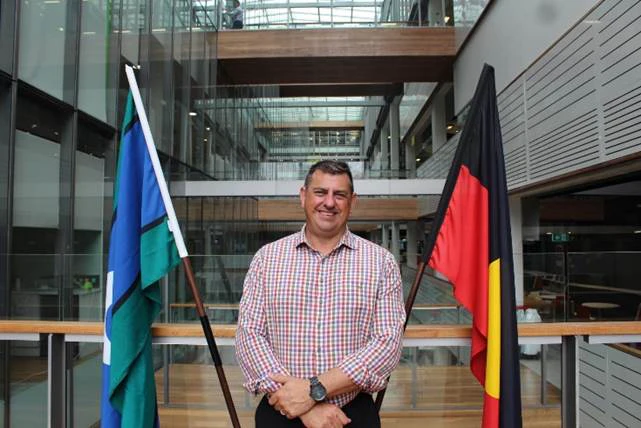
It was not until his mid-teens that Scott Avery was diagnosed with profound hearing impairment. He now uses a cochlear implant and had tried accessing the NDIS a few years ago, but was bogged down by the complexities and peculiarities of the scheme.
“I had to complete a ‘hearing handicap audit’ and basically disable myself to prove how ‘handicapped’ I was by my hearing. This was too demeaning, so I gave up after a few months,” says Avery, who is from Worimi Country in New South Wales.
He says, “I just wanted to talk with an Aboriginal person for my eligibility assessment because the ‘medical model of disability’ thinks we are all broken. It's a modus operandi of ‘we'll just fix you’ for a lot of government systems. This has a negative impact on people’s social and emotional well-being.”
Avery has been a researcher in the Aboriginal disability sector for over a decade and says there is still a long way to go in talking about disability in the Aboriginal rights space. “We haven't created enough momentum and critical mass in shifting people’s mindsets about the bigger picture around what disability is and what it means for Aboriginal people – one can have a disability and still be a proud sovereign person.”
His book, Culture is Inclusion: A narrative of Aboriginal and Torres Strait Islander people with disability, published by First Peoples Disability Network in 2018, combines the Indigenous concept of ‘yarning’ with traditional research methods.
He says, “People can’t conceive of an Aboriginal researcher with a disability. There’s a few of us who have actively asserted disability identity in our research. When I tell people that I’m Aboriginal and I’m doing research in the community, I’m told that’s not research, but activism. We get sidelined and the value of our research diminishes so we can't have policy influence.”
One of the uniform findings of his research was that being Aboriginal and having a disability compounds the inequality and structural barriers - whether it is access to the NDIS, housing, education or health.
“It pushes the person to the margins. The other interesting aspect was that Aboriginal people with a disability participate in their community and culture at the same rate as people without disability. For them, besides the medical and social models of disability, there is a cultural model based on inclusiveness and that is antithetical to how the NDIS is designed,” he adds.
He noted a lack of meaningful engagement around Aboriginal cultural understanding in the July 2021 progress update on the NDIS Aboriginal and Torres Strait Islander Engagement Strategy.
“I just don’t see the NDIS shifting in terms of its attitudes and philosophies,” says Avery. “A person is still seen as a client or a participant, and not part of the system. In our research, we found people avoiding to engage because they expect to be discriminated against, given the historic colonial legacy. Even if you have the best services on the ground, if people are wary of engaging, it’s of no use. We call that ‘apprehended discrimination’ which spans across the health sector, and not just the NDIS.”
Avery felt nothing will change unless it was taught, so he made the leap from working in a community organisation to academia. He now teaches an Indigenous unit, and a community management and organisation unit in Western Sydney University.
“Next year, for the first time we will have a unit on Indigenous disability. We have to teach this to the young before they get into positions where they’re making decisions in the system. It’s like a pointy end of the knife that's going to open things up. Even if we have a few hundred students each semester, in a couple of years we will have thousands of students armed with knowledge and an active interest in Indigenous disability. This is probably the most strategic thing which can help change attitudes,” says Avery.

Neena Bhandari
Neena Bhandari is a an award-winning journalist and foreign correspondent. She writes for various international and national media outlets on a wide range of subjects, including health and science, disability and the NDIS. She has lived experience of polio and has written extensively on poliomyelitis and post-polio syndrome/late effects of polio, including for the British Medical Journal. Through her writings, she hopes to bring the focus on disability issues from the margins to mainstream media.