
An opinion piece by Jax Jacki Brown
It’s Disability Pride Month! Well, it’s actually coming to an end in a few days’ time, at the end of July. I had meant to share some reflections on disability pride before now, but health stuff and being in lockdown in Melbourne has gotten in the way of my writing this. It’s hard not to feel your motivation take a dip at this time…#lockdownrealness
I’ve been practicing my disability pride for a long time now, but I actually hadn’t read up on or engaged with Disability Pride Month until recently, as it’s not something we really celebrate widely in Australia. Disability Pride Month has its roots in Disability Pride Day, which first began in 1990 with the passing of the Americans with Disabilities Act on the 26th of July 1990. It runs for the month of July each year and is about promoting and celebrating disability pride.
The concept that a disabled person can feel proud of who they are and, indeed, can love their disability, runs counter to the common perception of disability as tragedy and the assumption that people with disabilities should seek to hide or feel ashamed of our difference. Disability Pride instead proclaims that disability is an aspect of culture and identity, and that many of the barriers disabled people face are due to an inaccessible society and not because our bodies or minds are different.
Disability pride seeks to reclaim the word disability, from being seen as a negative thing, to a word of pride, meaning and power. I’ve only recently learned that there is a Disability Pride Flag which was created by Ann Magill, a disabled woman.
I’ve only recently learned that there is a Disability Pride Flag which was created by Ann Magill, a disabled woman. The meaning behind the design is outlined as follows by The Flags for Good Movement:
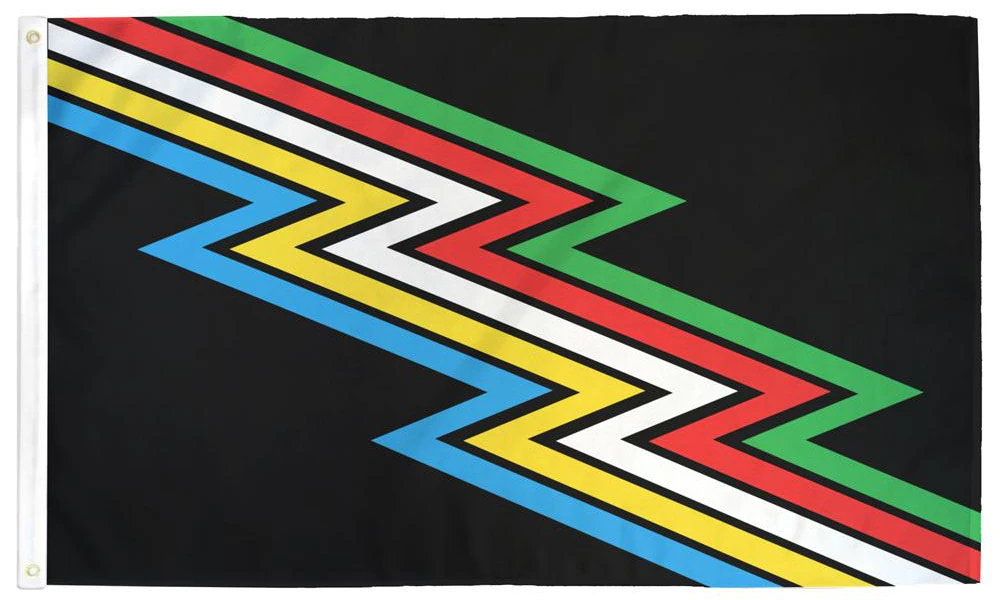
The Black Field: A colour of mourning; for those who have suffered from ableist violence, and also rebellion and protest.
The Zigzag/Lightning Bolt: How disabled people must navigate barriers, and the creativity in doing so; breaking free from normative authority and body control.
The Five Colours: The variety of needs and experiences (mental illness, intellectual and developmental disability, invisible and undiagnosed disabilities, physical disability, and sensory disabilities).
The Parallel Stripes: Solidarity within the disability community and all its differences.’
It’s been a long journey to get to a place of feeling disability pride, and if I’m being honest, there are days I don’t always feel it. But I’ve learnt those feelings will pass and I will feel pride in myself again.
There is a beautiful poem called You Get Proud by Practicing, by Laura Hershey, which explores the idea that pride is not just something we arrive at one day and have forever from then on. Pride is something we need to practice, to work on. It can drop and wane sometimes and that’s ok.
I love this poem because it tells folks with disabilities that pride is possible, and that shame can be worked through. Much of the shame I used to feel was because I had internalised the messages society was giving me that by having a disability I was of lesser value – that I was a burden on society and those who loved me. These messages are not true, but they have an impact on self-esteem and self-worth. For this reason, I particularly love the last stanza of the poem as it provides a path towards disability pride:
Remember, you weren’t the one
Who made you ashamed,
But you are the one
Who can make you proud.
Just practice,
Practice until you get proud, and once you are proud,
Keep practicing so you won’t forget.
You get proud
By practicing.
There have been a number of important people in my life who have nurtured my disability pride. The late and great Stella Young was one of them who I looked up to, admired and listened to. She also found meaning in the words of Laura Hershey’s poem and had ‘You get proud by practising’ on her inner arm. As Stella said, it “takes a lot of work to be proud of who you are in the face of persistent exclusion”.
Growing up with my disabilities, going through segregated schooling and having a lot of painful therapies done to my body as a young person, for a long time, I only felt shame in my disabilities. Pride wasn’t something that I could have imagined I would be able to feel one day – and I didn’t think my disabilities could be valued and loved. I had no sense that disability could be an aspect of identity, something I could love about myself, and others would love about me.
Growing up, the medical model of disability was the only way of viewing the disability I had. Under the medical model, disability is something to be fixed, cured or eradicated. The ‘problem’ of disability under this model is a personal/individual problem. However, in the 1980s in the UK, in direct response to the medical model and developed from the burgeoning disability rights movement, came the social model of disability.

The social model of disability states that many of the problems in the lives of people with disability are because society is inaccessible in a number of important and impactful ways: transport, buildings, houses, lack of employment opportunities, lack of education etc. The social model of disability argues it is all these things that create disability.
The social model of disability makes an important distinction between impairment and disability: “Impairment is the functional limitation within the individual caused by physical, mental or sensory impairment. Disability is the loss or limitation of opportunities to take part in the normal life of the community on an equal level with others due to physical and social barriers.” (Disabled People’s International, DPI, proceedings of the First World Congress, Disabled People’s International, 1982).
So, under the social model of disability, to say ‘I am disabled’ is to say that you are disabled by an inaccessible society and are part of a minority group of people with disabilities fighting for equal access and human rights! Understanding that disability is not a personal flaw or problem, but a structural issue of access and inclusion, has been really important for me in unlearning some of my shame and allowing me to practice my disability pride.
Disability is an aspect of human variation – it’s part of human diversity. It’s part of all the different ways human minds and bodies can manifest. It’s part of life, and part of what makes us human. People with disabilities make up around 20% of the population, that’s one in five people. Up to 80% of disabilities are invisible but because of the shame around disability and shame many people have about asking for access or support, many people with invisible disabilities try and hide them.
For me, as a gender diverse, queer disabled person, the connection with disability pride to trans pride or queer pride is important. Feeling proud, finding self-worth and surrounding yourself with people who love and value you, just as you are, is an important act of self-care and builds resilience.
Jax Jacki Brown (they/them) is a disability and LGBTIQA+ rights activist, writer, and educator. Jax has written for Junkee, Daily Life, The Feminist Observer, Writers Victoria, ABC’s Ramp Up, Hot Chicks with Big Brains and Archer Magazine. Jax is published in the following anthologies: Queer Disability Anthology (2015), QueerStories: Reflections on Lives Well Lived from Some of Australia's Finest LGBTIQA+ Writers (2018), Kindred: 12 Queer #LoveOzYA Stories (2019), Growing up Queer in Australia (2019) and the forthcoming We’ve Got This: Stories by Disabled Parents (2022). Jax is interested in how we can build resilience, pride and community for people with disabilities.
Discover more
Jax Jacki Brown
Jax Jacki Brown (they/them) is a disability and LGBTIQA+ rights activist, writer, and educator. Jax has written for Junkee, Daily Life, The Feminist Observer, Writers Victoria, ABC’s Ramp Up, Hot Chicks with Big Brains and Archer Magazine. Jax is published in the following anthologies: Queer Disability Anthology (2015), QueerStories: Reflections on Lives Well Lived from Some of Australia's Finest LGBTIQA+ Writers (2018), Kindred: 12 Queer #LoveOzYA Stories (2019), Growing up Queer in Australia (2019) and the forthcoming We’ve Got This: Stories by Disabled Parents (2022). Jax is interested in how we can build resilience, pride and community for people with disabilities.